
Introduction
Installing flag drippers correctly is what turns a drip layout from a basic watering system into a precise, maintainable irrigation setup. This guide explains how to place, connect, and test flag drippers so water reaches the root zone efficiently while avoiding common problems such as clogging, uneven flow, and misplaced emitters. You’ll also learn how flow rate, tubing position, and plant type affect installation choices in landscape beds, shrubs, and mixed plantings. With these steps in mind, the rest of the article walks through the process from planning and component selection to final checks and routine maintenance.
Why flag drippers matter in landscape irrigation
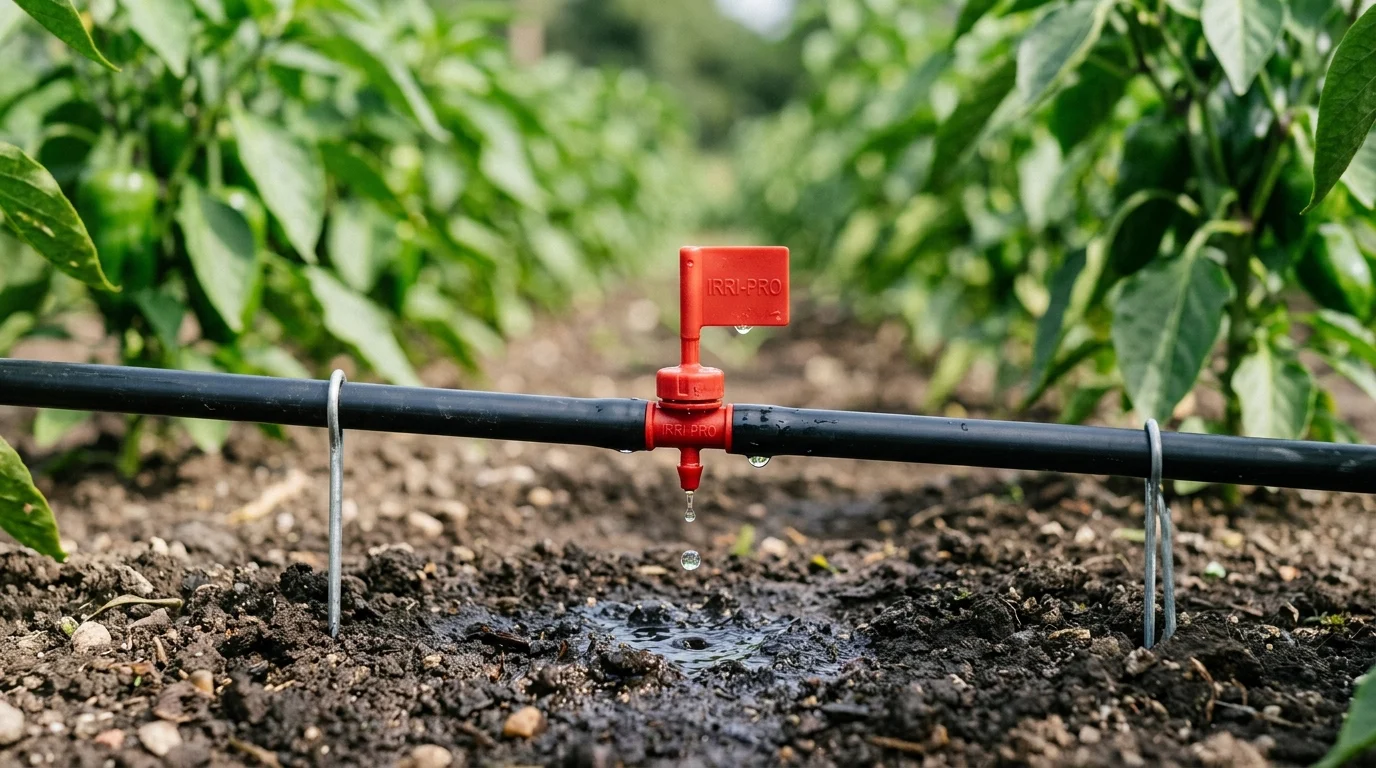
Flag drippers represent a cornerstone of localized micro-irrigation, offering an optimal balance between precision water delivery and field maintainability. Characterized by their distinct, flag-shaped top, these emitters allow for rapid visual identification and manual flushing—a feature largely absent in standard inline or button emitters. In commercial and high-density residential landscapes, deploying the correct emission device determines the long-term viability of the planting material.
Operating typically within a flow range of 0.5 to 4.0 gallons per hour (GPH), flag drippers deliver water directly to the root zone. This localized application limits evaporation and runoff, enabling landscape contractors and property managers to meet increasingly stringent municipal water conservation mandates while sustaining plant health.
When flag drippers are the right choice
Flag drippers are particularly advantageous in environments where water quality is inconsistent or where high levels of particulate matter threaten to foul irrigation systems. Unlike sealed button drippers, the take-apart mechanism of a flag dripper allows maintenance personnel to manually clear obstructions without replacing the entire unit. This makes them the definitive choice for setups utilizing reclaimed water or secondary agricultural water sources.
Furthermore, flag drippers excel in mixed-planting landscapes. Because they are punched directly into solid polyethylene (PE) distribution tubing, installers can place emitters at highly customized intervals. This modularity is essential when irrigating adjacent plants with vastly different water requirements, such as establishing a mature tree requiring 4.0 GPH next to drought-tolerant shrubs needing only 1.0 GPH.
How they affect installation quality and water use
The physical design of the flag dripper inherently improves installation quality control. The extended flag acts as a visual indicator, allowing site supervisors to quickly verify emitter placement, alignment, and color-coded flow rates from a distance. This reduces the time required for punch-list inspections on large commercial sites by up to 20 percent.
From a water utilization standpoint, transitioning from traditional overhead spray heads to targeted flag dripper arrays can yield water savings of 30 to 50 percent. By applying water at a slow, controlled rate—typically matched to the soil's infiltration capacity—flag drippers prevent surface pooling and ensure deep percolation, which encourages robust, drought-resistant root development.
How to select the right flag dripper

Selecting the correct flag dripper dictates the hydraulic efficiency and biological success of the irrigation system. System designers must evaluate specific landscape variables, including soil type, topography, and plant water demand, to specify emitters that will perform reliably under site-specific hydrostatic conditions.
Key specifications: flow rate, pressure, and connection size
The three primary specifications for any flag dripper are flow rate, operating pressure, and connection size. Flow rates are universally color-coded by manufacturers, though standards can vary slightly. Most commercial applications rely on 1.0 GPH (often black or blue), 2.0 GPH (green), and 4.0 GPH (red) variants. Operating pressure typically ranges from 10 to 50 PSI, requiring pressure regulation at the valve manifold.
Connection sizes are standardized to a 1/4-inch barbed inlet, designed to friction-fit into 1/2-inch or 3/4-inch solid PE tubing. The barb's design ensures a watertight seal up to the emitter's maximum rated pressure.
| Specification | Standard Range / Options | Primary Application |
|---|---|---|
| Flow Rate | 0.5, 1.0, 2.0, 4.0 GPH | Matches plant water demand and soil infiltration |
| Operating Pressure | 10 – 50 PSI | Determines need for inline pressure regulators |
| Inlet Size | 1/4-inch barb (approx. 4mm) | Standard PE tubing insertion |
| Filtration Requirement | 120 to 150 mesh | Prevents internal diaphragm fouling |
Pressure-compensating vs non-pressure-compensating models
The distinction between pressure-compensating (PC) and non-pressure-compensating (NPC) flag drippers is critical for system uniformity. PC flag drippers contain a silicone diaphragm that flexes based on incoming water pressure. This ensures that the emitter delivers a constant flow rate (e.g., exactly 2.0 GPH) whether the localized pressure is 15 PSI at the end of a lateral line or 45 PSI near the valve.
Conversely, NPC flag drippers operate on a turbulent flow principle where the output varies directly with pressure. If an NPC system experiences a pressure drop of 20 PSI across a 200-foot run of tubing, the emitters at the end of the line will deliver significantly less water than those at the beginning, leading to uneven plant growth.
How to compare options for different landscape needs
Comparing PC and NPC options requires analyzing the specific landscape topography. For flat terrain with short lateral runs (under 100 feet), NPC flag drippers offer a cost-effective solution with excellent reliability, as they lack the internal diaphragm that can sometimes degrade over decades. However, for landscapes with elevation changes exceeding 5 feet, or long lateral runs, PC drippers are mandatory to prevent the lower elevations from over-watering while the higher elevations dry out.
Additionally, when utilizing water sources with high dissolved solids or silt, NPC drippers with larger turbulent flow paths may resist calcification better than complex PC diaphragms, provided the system is flushed regularly.
How to install flag drippers correctly
Precision during the physical installation of flag drippers prevents long-term maintenance liabilities, such as blowouts, weeping connections, and uneven distribution. A systematic approach to tubing preparation, punching, and commissioning ensures the hydraulic integrity of the micro-irrigation network.
Pre-installation checks for tubing, filtration, and layout
Before any emitters are installed, the foundation of the system must be verified. The primary distribution tubing (typically 1/2-inch or 3/4-inch PE) must be laid out and allowed to relax under solar heat to prevent subsequent contraction from pulling emitters out of alignment. Tubing should be staked every 3 to 5 feet to maintain positioning.
Filtration and pressure regulation must also be confirmed at the zone valve. A minimum of a 120-mesh (130-micron) screen or disc filter is required to protect flag drippers from particulate clogging. Furthermore, a pressure regulator must be installed to step down municipal static pressures (often 60-80 PSI) to a safe operating range of 25 to 30 PSI, preventing catastrophic emitter blowouts.
Step-by-step installation and punching method
The physical insertion of the flag dripper requires a specialized punch tool designed specifically for 1/4-inch barbs. Installers must use a 3mm or 250-barb punch tool to create a clean, circular pilot hole. Using a generic awl or a knife creates irregular slits that will inevitably leak under pressure.
To install, the technician presses the punch tool firmly into the tubing at a 90-degree angle, ensuring it pierces only the top wall. The flag dripper is then immediately pressed into the hole until a distinct 'pop' is felt, indicating the barb has seated against the interior wall of the tubing. Installers must avoid 'double punching' or wiggling the tool, as stretching the PE tubing compromises the friction seal.
Commissioning checks for flow and uniformity
Once the zone is fully populated with emitters, commissioning checks are necessary to validate the installation. The system should be pressurized to its design operating pressure (typically 25 PSI) and allowed to run for 10 minutes. During this time, technicians must walk the lateral lines to inspect every barb connection for micro-leaks or weeping.
To verify flow uniformity, a volumetric catch-can test can be performed on a random sample of emitters. By placing a graduated cylinder under a 2.0 GPH flag dripper for exactly one minute, the technician should collect approximately 126 milliliters of water. A variance of more than 10 percent indicates potential debris in the line, a defective batch of emitters, or inadequate pressure regulation.
Common problems and maintenance fixes
While flag drippers are engineered for durability, yielding a typical lifecycle of 7 to 10 years in commercial environments, field variables inevitably introduce operational challenges. Establishing routine troubleshooting protocols allows maintenance teams to rapidly diagnose and rectify issues before they result in plant mortality.
Frequent installation mistakes to avoid
The most frequent installation mistake is utilizing an oversized punch tool, such as a 4mm punch for a 3mm barb. This error typically results in a 10 to 15 percent blowout rate during peak pressure cycles. If a hole is punched too large, the only permanent fix is to install a 1/4-inch goof plug and punch a new, correctly sized hole at least two inches away.
Another common error is installing flag drippers on the underside of the tubing. While this might seem aesthetically pleasing by hiding the emitter, it forces the dripper to act as a low-point drain. When the system shuts off, sediment and debris in the line will settle directly into the downward-facing emitter, drastically accelerating clogging.
How to handle clogging, leaks, and loose fittings
The primary advantage of the flag dripper is its maintainability in the face of clogging. When an emitter stops flowing, a technician can simply twist the flag mechanism to temporarily open the internal pathway, allowing the system's pressure to flush out accumulated sediment or biological growth. If the clog is severe, the top can be completely removed, cleaned, and snapped back into place.
For leaks at the barb connection, the issue is almost always a compromised tubing wall. Loose fittings cannot be glued or taped; the emitter must be removed, the hole plugged, and the emitter relocated. In areas with hard water, calcium carbonate buildup can fuse the flag mechanism. In such cases, periodic acid washing of the system (injecting a mild phosphoric acid solution to drop the pH to 4.0 for a short duration) dissolves mineral scaling.
| Symptom | Primary Cause | Recommended Corrective Action |
|---|---|---|
| No flow from emitter | Particulate clogging or mineral scale | Twist flag to flush; remove top to clean; check zone filter |
| Weeping at tubing insertion | Irregular punch hole or stretched tubing | Remove emitter, insert goof plug, punch new hole |
| Emitter blows out of tubing | Excessive system pressure (>40 PSI) | Verify inline pressure regulator is functioning at 30 PSI |
| Inconsistent flow across zone | Lack of pressure compensation on slopes | Upgrade to PC flag drippers; check for lateral line breaks |
Troubleshooting visible field symptoms
Visible field symptoms often point directly to emitter performance issues. Localized dry spots in an otherwise healthy bed suggest completely clogged drippers or a severed lateral line upstream. Conversely, severe puddling around a specific plant indicates an emitter whose flag has been accidentally popped open, turning a 2.0 GPH drip into a steady 15.0 GPH stream.
Audible cues are also valuable during troubleshooting. A high-pitched whistling sound emanating from the flag drippers strongly indicates excessive pressure, usually exceeding 40 PSI. This requires immediate investigation of the zone's pressure regulator, as sustained high pressure will eventually cause widespread emitter blowouts and potential damage to the lateral tubing.
When to standardize on flag drippers
For commercial landscape contractors and institutional grounds management teams, standardizing irrigation components across a portfolio reduces operational overhead. Migrating to a uniform flag dripper standard simplifies procurement, training, and long-term asset management.
Cost, labor, inventory, and lifecycle factors
From a procurement standpoint, flag drippers are highly cost-effective, typically ranging from $0.15 to $0.35 per unit depending on PC capabilities and bulk volume. Standardizing on a single brand and model reduces the number of SKUs a contractor must hold in inventory. This prevents the common inefficiency of technicians carrying dozens of incompatible emitter types, which often leads to improvised, subpar field repairs.
Labor costs are also positively impacted by standardization. When field crews are trained on a single type of flag dripper, the time required to diagnose a malfunction, flush a clogged unit, or replace a damaged emitter drops significantly. Over a 10-year lifecycle, the labor savings derived from rapid, standardized maintenance far outweigh the initial capital expenditure of the emitters themselves.
How to build a practical standard for teams and sites
Building a practical standard requires creating a clear, documented specification sheet for all internal teams and external subcontractors.
Key Takeaways
- The most important conclusions and rationale for flag drippers
- Specs, compliance, and risk checks worth validating before you commit
- Practical next steps and caveats readers can apply immediately
Frequently Asked Questions
What flow rate should I choose for flag drippers?
Match the dripper to plant needs and soil. Use 1.0 GPH for small shrubs, 2.0 GPH for medium plants, and 4.0 GPH for trees or thirsty plants; slower rates suit clay soils better.
When should I use pressure-compensating flag drippers?
Use pressure-compensating models on slopes, long tubing runs, or zones with uneven pressure. They help each plant receive a more consistent flow from start to end of the line.
What tubing and hole size do flag drippers fit?
Most flag drippers use a 1/4-inch barbed inlet and are punched into 1/2-inch or 3/4-inch solid PE tubing. Use the manufacturer’s punch tool for a snug, leak-resistant fit.
Do flag drippers need a filter and pressure regulator?
Yes. Install 120 to 150 mesh filtration to reduce clogging and keep zone pressure within the dripper’s rating, commonly around 10 to 50 PSI, using a pressure regulator if needed.
How do I fix a clogged flag dripper?
Open or remove the flag dripper, flush out debris, and run water briefly to clear the line before reinstalling it. This is especially useful on systems using reclaimed or dirty water sources.