
Introduction
Clogging in drip irrigation fittings often starts long before a complete blockage appears, reducing flow uniformity and putting pressure on the entire system. Because take-offs, tees, elbows, and couplings interrupt water movement, they can trap sediment, encourage mineral buildup, and support biological growth even when emitters seem unaffected. This article explains why fittings become choke points, which physical, chemical, and biological factors are most responsible, and how design, filtration, flushing, and maintenance practices can prevent problems. By the end, readers will have a practical framework for keeping drip lines clear, stable, and efficient over time.
Why Drip Irrigation Fittings Clog
Drip irrigation systems are designed to deliver precise water volumes, typically operating at micro-flow rates between 0.5 and 4.0 liters per hour (L/h). At these low velocities, maintaining an unobstructed flow path is critical. While much of the industry focus remains on emitter clogging, drip irrigation fittings—such as take-offs, couplings, tees, and elbows—are equally vulnerable pinch points. Fittings inherently alter the internal geometry of the irrigation lateral, creating micro-turbulences and flow velocity drops that encourage the accumulation of particulate matter and chemical precipitates. Understanding the mechanics of fitting blockages is the first step in engineering a resilient, high-uniformity irrigation network.
Physical, Chemical, and Biological Causes
Clogging mechanisms in drip irrigation fittings are categorized into three primary domains: physical, chemical, and biological. Physical clogging occurs when suspended inorganic solids, such as sand, silt, and clay particles, settle in the transitional zones of a fitting where water velocity decreases. Chemical clogging is driven by the precipitation of dissolved solids. When irrigation water has a pH exceeding 7.5 and high concentrations of calcium, magnesium, or iron, temperature fluctuations and pressure drops inside fittings trigger the formation of scale (calcium carbonate) or iron oxides. Biological clogging results from organic matter, including algae, bacteria, and microbial slimes. These organisms thrive in the nutrient-rich, low-light environments of irrigation pipes, anchoring themselves to the internal ridges of barbed fittings and acting as a sticky matrix that traps further physical and chemical debris.
How Contaminants Enter the System
Contaminants infiltrate irrigation infrastructure through multiple vectors. The most common entry point is the primary water source, particularly open reservoirs and canals carrying high loads of Total Suspended Solids (TSS). Even in closed groundwater systems, sand pumping from degrading wells introduces abrasive and obstructive particulates. Beyond the source, contaminants routinely enter through system vulnerabilities. Soil ingestion during lateral draining—a phenomenon known as back-siphoning—pulls mud directly into emitters and end-line fittings. Additionally, breaks in mainlines or improper field handling during system assembly can introduce macro-debris like plastic shavings, soil, and vegetation directly into the pipeline, which subsequently wedge into the narrowest apertures of downstream fittings.
Operational and Cost Impacts
The operational consequences of clogged fittings cascade rapidly through an agricultural enterprise. A partially obstructed fitting increases localized head loss, forcing the irrigation pump to overcome higher friction. System operators often observe a 15% to 20% increase in pump energy consumption just to maintain baseline operating pressures. More critically, blockages degrade Distribution Uniformity (DU). When DU falls below the industry benchmark of 85%, crop yields suffer due to uneven water and fertigation delivery, leading to localized drought stress or nutrient toxicity. The financial penalty includes not only a potential 10% to 15% reduction in marketable yield but also the escalating labor costs associated with manually locating, excavating, and replacing clogged micro-fittings across hundreds of hectares.
Fitting Specifications That Affect Clogging Resistance
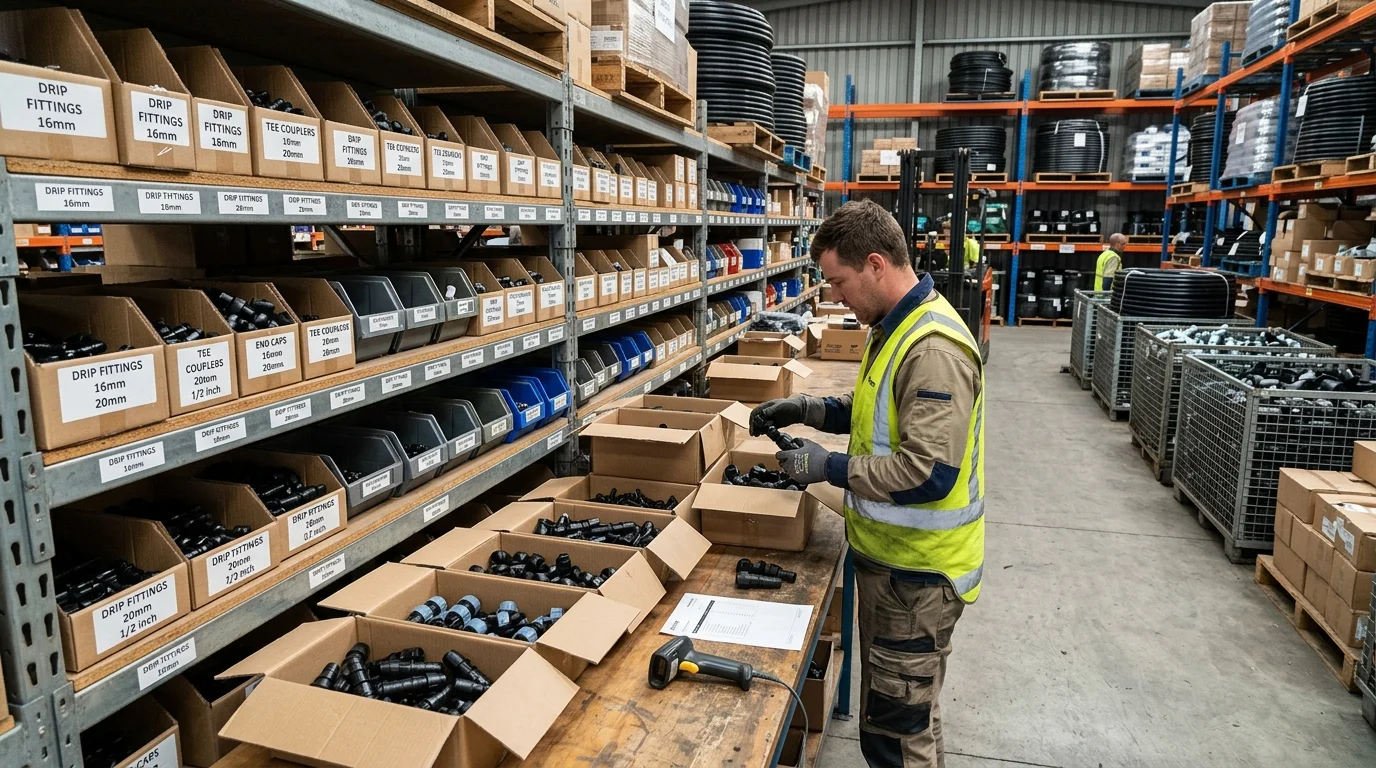
The physical architecture and material composition of drip irrigation fittings dictate their susceptibility to blockages. When water transitions from a sub-main line into a lateral through a take-off fitting, or navigates a 90-degree elbow, the fluid dynamics change abruptly. Buyers must evaluate fitting specifications not merely for leak prevention, but for their hydrodynamic efficiency to ensure particulates remain in suspension until they are flushed from the system.
Passage Geometry and Connector Design
Passage geometry is the most critical design factor influencing a fitting's clogging resistance. Abrupt changes in internal diameter or sharp, unradiused corners create dead zones where flow velocity drops below the critical threshold of 0.3 meters per second (m/s). At velocities below this metric, heavier suspended solids inevitably settle. Insert or barbed fittings, by design, reduce the internal diameter of the pipe, creating a physical restriction and a downstream turbulent wake. Conversely, premium fittings feature tapered internal transitions and smooth bores that maintain laminar flow, minimizing the pressure differential that triggers chemical precipitation and preventing the physical settling of silt.
Materials, Wall Thickness, and Manufacturing Tolerances
Material selection and manufacturing precision directly impact the internal surface friction of a fitting. High-grade polymers such as Polyacetal (POM) and UV-stabilized Polypropylene (PP) are favored for their chemical inertness and ability to be molded with exceptionally smooth internal surfaces (surface roughness, Ra, of less than 0.8 µm). A smoother internal wall provides fewer anchor points for bacterial biofilms and scale. Furthermore, wall thickness—typically ranging from 1.5 mm to 2.5 mm for heavy-duty applications—prevents the fitting from warping under high summer temperatures or operating pressures. Poor manufacturing tolerances often leave microscopic plastic flashing or burrs inside the fitting; these defects act as immediate catch-points for organic matter and synthetic fibers.
Key Comparison Criteria for Buyers
When evaluating fittings for clogging resistance, agronomists and procurement managers must balance hydraulic efficiency with mechanical security. The table below outlines key comparison criteria across common fitting architectures.
| Fitting Type | Internal Flow Restriction | Max Operating Pressure | Clogging Risk Factor | Ideal Application |
|---|---|---|---|---|
| Standard Barbed / Insert | High (Reduces ID by 10-20%) | 3.0 to 4.0 bar | Moderate to High | Short-term seasonal crops, clean water |
| Tape Loc / Nut (External) | Low (Compresses outer wall) | 2.0 to 3.0 bar | Low | Thin-wall drip tape, high biological risk |
| Thick-Wall Compression | Minimal (Flush internal alignment) | Up to 8.0 bar | Very Low | Multi-season orchards, heavy fertigation |
Matching Water Quality Management and Filtration
Preventing clogs at the fitting level is impossible without a comprehensive water quality management and primary filtration strategy. Fittings are only as reliable as the water passing through them. By establishing strict water quality parameters and implementing robust chemical and mechanical interventions, operators can neutralize physical, chemical, and biological threats before they reach the lateral lines.
Water Quality Indicators, Filter Types, and Micron Ratings
Filtration requirements must be dictated by comprehensive water analysis. Key indicators include Total Suspended Solids (TSS), biological oxygen demand (BOD), and dissolved mineral concentrations. For standard drip irrigation networks, the industry consensus mandates primary filtration of 120 to 130 mesh (approximately 125 to 130 microns). Screen filters are generally sufficient for inorganic groundwater sources, while disk filters provide three-dimensional depth filtration better suited for capturing deformable biological matter. For surface water sources with TSS exceeding 50 ppm or high algae loads, sand media filters backed by secondary screen filters are required to ensure particulate loads do not overwhelm the micro-fittings.
Flushing, Chemical Treatment, and Maintenance Intervals
Mechanical filtration must be paired with routine flushing and chemical treatments to manage dissolved solids and biofilms. To dissolve calcium carbonate scale that builds up on fitting ridges, system pH should be periodically lowered to between 5.5 and 6.0 via acid injection (using phosphoric, sulfuric, or N-phuric acids). To combat biological slimes, chlorine injection is the standard protocol; this can be administered as a continuous low-dose treatment (1 to 2 ppm free residual chlorine at the end of the lateral) or as a periodic shock treatment (10 to 20 ppm). Furthermore, mechanical flushing of the mainlines, sub-mains, and laterals must achieve a minimum scour velocity of 0.5 m/s to dislodge settled debris from the bottom of fittings and pipes.
Inspection and Troubleshooting Steps
Proactive inspection prevents minor accumulations from becoming catastrophic blockages. Operators should continuously monitor the pressure differential across the primary filtration battery; an automatic backflush should trigger, or manual cleaning should commence, when the differential reaches 0.3 to 0.5 bar. In the field, troubleshooting involves regular visual and hydraulic inspections of end-line fittings and flush valves. If sediment is heavily concentrated at the terminal fittings during a routine flush, it indicates that the primary filtration micron rating is inadequate for the current water profile, or that a filter element has been breached.
Procurement, Installation, and Operating Practices
The integrity of a drip irrigation system relies heavily on the standards upheld during procurement, field handling, and installation. Even the most hydrodynamically advanced fittings will fail if they are poorly manufactured, mismatched to the local water chemistry, or compromised by sloppy installation practices that introduce foreign debris into the hydraulic network.
How to Compare Suppliers
Comparing suppliers requires moving beyond unit price and examining quality assurance metrics. Professional-grade fittings should comply with international standards such as ISO 9261, which governs agricultural irrigation equipment. Buyers should request data on manufacturing defect rates, seeking an Acceptable Quality Limit (AQL) of strictly less than 1.0%. Additionally, suppliers should provide empirical data on the UV resistance of their polymers and the chemical compatibility of their fittings with aggressive fertilizers and agricultural acids, ensuring the plastic will not embrittle or degrade internally over a 5- to 10-year lifecycle.
Installation Errors and Field Handling Risks
Field installation is a highly vulnerable phase for clogging prevention. A prevalent error is allowing soil, PVC shavings, or trenching debris to enter the pipes during layout and assembly. If mainlines and sub-mains are not thoroughly flushed before the lateral lines and micro-fittings are connected, all construction debris will be forced directly into the narrowest passages of the system upon initial pressurization. Another common risk is the over-tightening of compression fittings or the improper insertion of barbed fittings, which can shave off thin ribbons of polyethylene pipe. These internal plastic shavings act as permanent, non-degradable obstructions that trap organic and inorganic matter.
Selecting Fittings by Water Source and Crop Needs
Fitting selection must be tailored to the specific intersection of crop type, lifespan, and water source. The following table illustrates how varying water sources dictate necessary filtration and the optimal fitting characteristics to mitigate clogging risks.
| Water Source | Primary Contaminant Risk | Minimum Filtration Standard | Optimal Fitting Characteristics |
|---|---|---|---|
| Deep Well / Groundwater | Dissolved minerals (Ca, Mg, Fe) | 120 Mesh / 130 Micron (Screen) | Chemically inert (POM/PP), thick-walled for frequent acid washes |
| Surface Water (Pond/Canal) | Biological (Algae), Silt, Clay | Media Filter + 120 Mesh Backup | Smooth internal bore (Ra < 0.8 µm), opaque UV-stabilized plastics |
| Municipal / Treated Effluent | Pathogens, Variable suspended solids | 130 Micron (Disk) | Wide internal passage, high resistance to chlorine and heavy metals |
Building a Long-Term Clogging Prevention Strategy
Transitioning from reactive unclogging to proactive prevention requires building a long-term maintenance strategy. By institutionalizing performance monitoring and understanding the lifecycle economics of irrigation components, agricultural enterprises can maintain high distribution uniformity while controlling operational expenditures.
Monitoring Records, Replacement Thresholds, and Service Schedule
s
Data-driven monitoring is the foundation of long-term clogging prevention. Operators must establish baseline flow rates and operating pressures when the system is newly installed and fully clean. A sustained 5% drop in total system flow at standard operating pressure is a definitive leading indicator of developing blockages within fittings and emitters. Service schedules should mandate weekly flushing, bi-weekly chlorination (depending on biological load), and seasonal acid washes. Replacement thresholds must also be codified; for instance, if an aggressive acid and chlorine wash fails to restore a lateral's flow rate to >90% of its baseline, the heavily scaled or fouled fittings should be systematically replaced rather than repeatedly and inefficiently cleaned.
Balancing Capital Cost, Maintenance, and Reliability
Ultimately, clogging prevention is an exercise in balancing capital expenditure against maintenance costs and systemic reliability. Procurement of premium, geometrically optimized fittings may carry a higher upfront cost—averaging $0.15 to $0.30 per unit compared to $0.05 for generic alternatives. However, this initial capital outlay is rapidly offset by operational savings. High-quality fittings reduce the labor required for manual field unclogging by 30% to 50% over the system's life. Furthermore, by protecting the hydraulic integrity of the network and preventing catastrophic blockages, premium fittings can extend the viable lifespan of an orchard or vineyard lateral system by 3 to 5 years, delivering a formidable return on investment through sustained crop yields.
Key Takeaways
- The most important conclusions and rationale for drip irrigation fittings
- Specs, compliance, and risk checks worth validating before you commit
- Practical next steps and caveats readers can apply immediately
Frequently Asked Questions
What causes drip irrigation fittings to clog most often?
Usually a mix of sand or silt, mineral scale from hard water, and biofilm from algae or bacteria. Take-offs, tees, and elbows clog faster because flow slows and debris settles there.
How can I reduce clogging in drip irrigation fittings before it starts?
Install proper filtration, flush laterals regularly, and keep water velocity above low-settling zones. Use smooth-bore, well-made fittings with tapered internal passages when possible.
Which fittings are most likely to clog?
Take-offs, elbows, tees, and small barbed connectors are common trouble spots. Their tighter passages and directional changes create dead zones where particles and scale accumulate.
Does water quality affect fitting blockage?
Yes. Water with high suspended solids, pH above 7.5, or elevated calcium, magnesium, or iron increases clogging risk. Test water regularly and treat filtration or chemistry issues early.
How often should drip irrigation fittings and lines be flushed?
Flush on a routine schedule based on water quality; many systems benefit from weekly or biweekly flushing during peak use. Flush sooner after repairs, dirty water events, or visible pressure drops.