
Introduction
Choosing between FN and RF nozzles affects far more than spray shape: it changes application rate, pressure demands, wind performance, and how well water actually reaches the root zone. In irrigation design, FN nozzles use a fixed fan pattern for fast, high-volume coverage, while RF nozzles break flow into rotating streams that apply water more slowly and evenly. Understanding that difference helps prevent runoff, dry spots, mismatched zones, and unnecessary maintenance. This article explains how each nozzle works, where each performs best, and what to consider when selecting one for residential or commercial landscape systems.
Why the Difference Between FN and RF Nozzles Matters
Selecting the correct irrigation nozzles dictates the hydraulic efficiency and agronomic success of any commercial or residential landscape system. Within the industry, the distinction between FN (Fixed Nozzle) and RF (Rotary Flow) architectures represents a fundamental divergence in water delivery mechanics.
Engineers must evaluate these components not merely as interchangeable emitters, but as specialized hydraulic devices that govern flow rates, droplet kinetics, and overall system pressure requirements.
How FN and RF nozzles affect spray
FN and RF variants fundamentally alter spray distribution patterns and droplet trajectories. Fixed nozzles emit a continuous, unbroken fan of water, relying on a static orifice to define the arc and radius. This creates a high-volume output that saturates the soil profile rapidly.
Conversely, rotary flow nozzles utilize a rotating deflector to divide the water into multiple, distinct trajectories. This multi-stream approach produces heavier, wind-resistant droplets while significantly slowing the application rate, optimizing soil absorption in challenging topographies.
How designation errors increase cost and maintenance
Misapplying these nozzle designations directly inflates operational expenditures and accelerates mechanical wear. Deploying an FN unit in a zone engineered for RF specifications often results in catastrophic runoff, as the soil infiltration rate cannot accommodate the aggressive precipitation.
Furthermore, mixing FN and RF nozzles on a single valve zone disrupts the matched precipitation rate (MPR) matrix. Because FN units typically deliver 1.5 to 2.0 inches per hour while RF units output a restrained 0.4 to 0.8 inches per hour, improperly combined zones force overwatering in some areas and severe deficit irrigation in others, driving up water utility costs by as much as 30% annually.
What FN and RF Nozzles Are
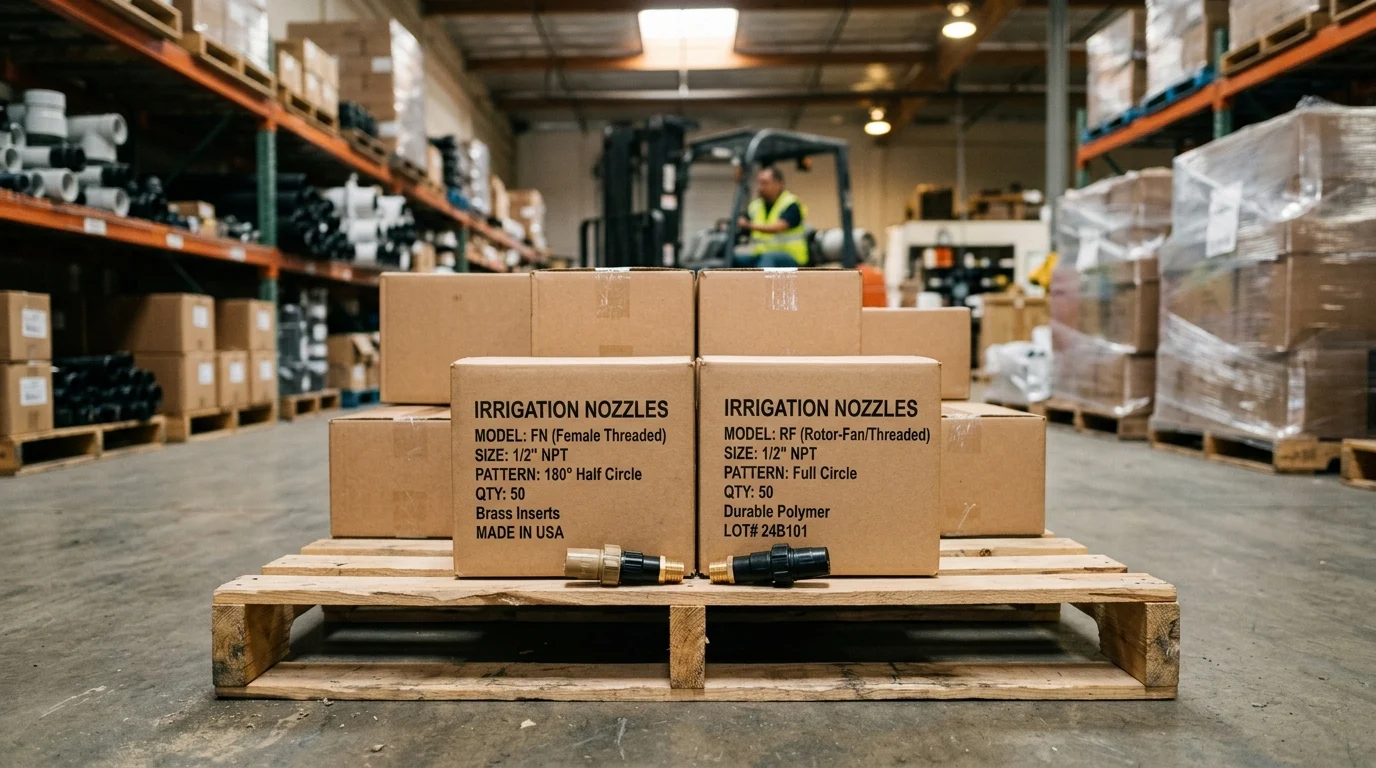
To specify irrigation components accurately, industry professionals must understand the internal engineering and fluid dynamics that define FN and RF nozzles. Both serve the primary function of atomizing and distributing water, but their internal geometries dictate entirely different operating profiles.
How an FN nozzle is defined
An FN (Fixed Nozzle) is engineered as a static emission device with no moving parts. Water is forced through a precision-molded orifice and directed by a stationary deflector shield, which determines both the trajectory angle and the spray arc.
This design prioritizes mechanical simplicity and maximum flow capacity. Standard fixed nozzles operate optimally at a baseline pressure of 30 PSI (2.1 bar), delivering a uniform, heavy mist. The static nature of the FN design ensures high reliability and a low initial unit cost, making it a ubiquitous standard in turfgrass management.
How an RF nozzle is defined
An RF (Rotary Flow) nozzle incorporates dynamic internal mechanisms, typically utilizing a viscous fluid stator or a silicone-damped gear drive to control rotation speed. As water flows through the nozzle base, it spins a multi-channeled deflector that organizes the stream into rotating fingers of water.
This mechanical resistance requires a higher baseline operating pressure, strictly demanding 40 to 45 PSI (2.8 to 3.1 bar) for optimal rotation and radius projection. The dynamic assembly of an RF nozzle produces larger droplet sizes—frequently exceeding 500 microns—which drastically reduces evaporation and wind drift compared to the finer mist generated by static alternatives.
How FN and RF Nozzles Compare
A side-by-side engineering comparison reveals that FN and RF nozzles are designed for distinct hydraulic environments. Specifiers must weigh precipitation metrics against installation variables to ensure system longevity and efficiency.
Key differences between FN and RF nozzles
The most critical divergence between these technologies lies in their precipitation rates and throw radii. Fixed nozzles are inherently limited in their reach, typically covering a radius of 4 to 17 feet, whereas rotary nozzles can effectively project water from 8 to 35 feet without requiring a larger rotor body.
| Specification | FN (Fixed Nozzle) | RF (Rotary Flow) |
|---|---|---|
| Precipitation Rate | 1.5 – 2.0 in/hr | 0.4 – 0.8 in/hr |
| Optimal Pressure | 30 PSI (2.1 bar) | 40 – 45 PSI (2.8 – 3.1 bar) |
| Throw Radius | 4 – 17 feet | 8 – 35 feet |
| Droplet Size | Fine / Susceptible to drift | Coarse / Wind-resistant |
Performance factors: installation, wear, and pressure
Performance over time is heavily influenced by water quality and system pressure. FN nozzles, lacking moving parts, are highly resistant to mechanical failure but are susceptible to clogging if fine particulates bypass the standard 40-mesh filtration screens.
In contrast, the internal stators of RF nozzles demand superior filtration, typically requiring 100-mesh screens to prevent abrasive wear on the rotating gears. Additionally, RF nozzles are highly sensitive to pressure deficits; dropping below 35 PSI can cause the rotation to stall entirely, whereas an FN nozzle will simply exhibit a reduced throw radius under similar pressure drops.
How to Evaluate FN and RF Nozzles for Purchase
Procurement of irrigation nozzles extends beyond basic unit cost, requiring a comprehensive evaluation of site topography, agronomic needs, and supply chain reliability. Buyers must align nozzle specifications with both immediate landscape requirements and long-term sustainability goals.
Practical steps for buyers and engineers
Engineers and buyers must first analyze the soil infiltration rate and site gradient. For heavy clay soils characterized by infiltration rates below 0.25 inches per hour, RF nozzles are mandatory to prevent surface pooling and runoff. Conversely, highly permeable sandy soils can easily absorb the aggressive 1.5 inches per hour output of FN units.
| Soil Type / Condition | Recommended Nozzle Type | Rationale |
|---|---|---|
| Heavy Clay / Slopes > 10% | RF (Rotary Flow) | Low precipitation rate prevents runoff |
| Sandy Soil / Flat Terrain | FN (Fixed Nozzle) | Fast application matches high infiltration |
| High Wind Areas | RF (Rotary Flow) | Larger droplets resist wind drift |
| Low Pressure Systems (<35 PSI) | FN (Fixed Nozzle) | Operates reliably at lower pressures |
Quality, compliance, and supply chain checks
Commercial procurement requires rigorous quality and compliance checks, particularly in regions enforcing strict municipal water codes. Buyers should verify that RF nozzles carry EPA WaterSense certification, which mandates a minimum distribution uniformity (DU) of 65% and guarantees at least 20% greater water efficiency over legacy models.
From a supply chain perspective, commercial buyers must account for minimum order quantities (MOQs) and lead times. Standard FN units are highly commoditized and typically available in MOQs of 500 units with immediate shipping, whereas specialized RF units may require MOQs of 1,000 units and carry lead times of 4 to 6 weeks during peak agricultural seasons.
Which Option Is Better: FN or RF
Determining whether FN or RF technology is superior depends entirely on the hydraulic and topographic constraints of the specific irrigation project. Neither nozzle type universally outperforms the other; instead, their efficacy is dictated by proper application.
When FN is the better choice
FN technology remains the optimal choice for small, intricately shaped turf areas that demand precise, short-range coverage. When irrigating flat terrain with highly permeable soil, the rapid application rate of a fixed nozzle minimizes system runtimes, conserving energy for the pumping infrastructure.
Furthermore, in legacy systems constrained by degraded pipe networks that can only sustain 25 to 30 PSI, FN units provide the most reliable mechanical performance, ensuring adequate coverage without the risk of stall-outs associated with under-pressurized rotary mechanisms.
When RF is the better choice
RF nozzles are definitively the better choice for modern, high-efficiency irrigation systems, particularly those facing strict environmental regulations. On sites featuring complex topography, such as slopes exceeding a 10% gradient, the low precipitation rate of RF units is the only viable method to ensure deep root saturation without erosive runoff.
Additionally, in regions prone to sustained wind speeds above 10 mph, the heavy, multi-trajectory droplets of RF nozzles maintain a high distribution uniformity, reducing wasted water by up to 30% compared to static misting alternatives. For commercial properties prioritizing LEED certification or municipal water conservation rebates, RF technology represents the standard for sustainable landscape engineering.
Key Takeaways
- The most important conclusions and rationale for irrigation nozzles
- Specs, compliance, and risk checks worth validating before you commit
- Practical next steps and caveats readers can apply immediately
Frequently Asked Questions
What is the main difference between FN and RF nozzles?
FN nozzles spray a fixed fan with higher precipitation, while RF nozzles rotate multiple streams at a slower rate. FN suits quick coverage; RF suits better soak-in and wider radius.
Can FN and RF nozzles be used on the same valve zone?
No. Their precipitation rates are very different, so mixing them causes overwatering in some areas and dry spots in others. Keep each zone matched to one nozzle type.
Which nozzle is better for slopes or clay soil?
RF nozzles are usually better because they apply water more slowly, helping reduce runoff and improve infiltration on tight soils and sloped areas.
What pressure do FN and RF nozzles typically need?
FN nozzles generally perform best around 30 PSI. RF nozzles usually need about 40 to 45 PSI to rotate correctly and maintain their intended throw.
When should I choose an FN nozzle instead of an RF nozzle?
Choose FN for small, tight areas that need short-radius coverage and simple, low-cost installation. They work well where runoff risk is low and pressure is moderate.