
Introduction
Choosing the right solenoid valve for irrigation affects far more than on-off water control: it shapes pressure stability, zone performance, energy use, and long-term maintenance demands. Different valve types respond differently to flow rate, line pressure, duty cycle, and controller signals, so a mismatch can lead to leaks, poor distribution, coil failure, or unreliable automation. This article explains the main solenoid valve types used in irrigation systems, how their operating principles differ, and which technical factors matter most when matching a valve to agricultural, landscape, or commercial applications. With that foundation, the details in the following sections will be easier to evaluate and apply.
Why solenoid valve selection matters in irrigation systems
Solenoid valves serve as the critical control interface between electronic irrigation controllers and the hydraulic distribution network. Selecting the precise solenoid valve irrigation components dictates system efficiency, water conservation, and overall hydraulic stability. In large-scale agricultural and commercial landscaping environments, the reliance on automated water delivery means that valve performance directly correlates to crop yield and landscape viability. Understanding the technical nuances of these electromechanical devices is the first step in engineering a robust irrigation architecture.
Valve type, duty cycle, and response characteristics
The fundamental architecture of a solenoid valve dictates its operational parameters, including its duty cycle and response time. Duty cycle refers to the percentage of time a valve can remain energized without overheating; irrigation systems typically require coils rated for 100% ED (Continuous Duty) to accommodate extended watering schedules during peak summer months. Response characteristics are equally critical. Direct-acting valves actuate rapidly, often within 20 to 100 milliseconds, whereas pilot-operated valves utilized in mainlines may take 1 to 5 seconds to fully open or close, relying on the fluid's pressure to shift the diaphragm.
Commercial and operational risks of wrong valve selection
Improper valve selection introduces severe commercial and operational vulnerabilities. Specifying a fast-acting valve on a high-velocity mainline can induce water hammer—a kinetic energy shockwave that generates pressure spikes exceeding 150 PSI, capable of fracturing PVC pipe networks and destroying downstream emitters. Conversely, utilizing a valve with an insufficient pressure rating can lead to diaphragm rupture and continuous uncontrolled flow. Electrically, selecting an AC solenoid for a remote zone with wire runs exceeding 3,000 feet without accounting for voltage drop can result in the coil receiving less than 19 VAC, leading to actuation failure, subsequent crop desiccation, and costly coil burnout.
Solenoid valve types used in irrigation systems
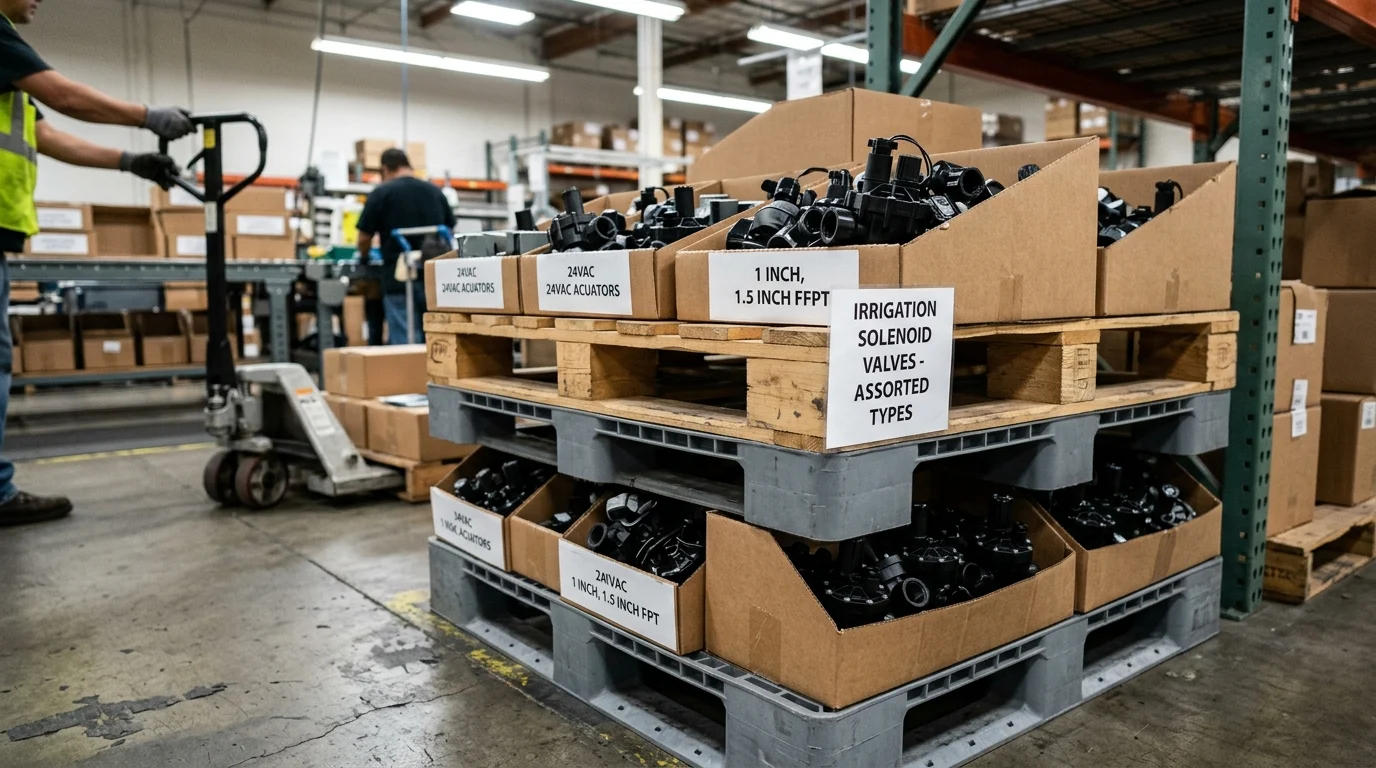
Irrigation systems rely on specific actuation mechanisms to manage varying flow rates, pressure differentials, and power constraints. The internal mechanical architecture of the valve determines its suitability for low-pressure gravity drip lines versus high-pressure commercial rotor zones. Engineers must evaluate several distinct valve topologies and component materials to match the hydraulic reality of the site.
Direct-acting, pilot-operated, and assisted-lift valves
Direct-acting valves utilize the electromagnetic force of the coil to directly lift the armature and seal off the orifice. These valves require no minimum pressure (0 bar) to operate, making them ideal for low-pressure gravity-fed irrigation lines or localized misting systems. Pilot-operated valves, the standard for most commercial irrigation, use a small internal port to direct line pressure to the top of a diaphragm. They require a minimum pressure differential—typically 0.3 to 0.5 bar (4.3 to 7.2 PSI)—to actuate. Assisted-lift valves combine both technologies, using the coil to lift the seal directly while utilizing line pressure to assist, ensuring operation even in zero-differential environments while maintaining high flow capacities.
Normally closed vs normally open valves
The resting state of the valve is a critical safety and operational design choice. Normally Closed (NC) valves are the ubiquitous standard in solenoid valve irrigation; they remain shut until electrically energized. This fail-safe design ensures that in the event of a power failure, water flow ceases, preventing catastrophic flooding. Normally Open (NO) valves, which allow flow until energized, are reserved for specialized applications such as frost protection systems or bypass loops, where continuous water movement is required during electrical outages. The choice heavily impacts energy consumption, as holding an NO valve closed requires continuous electrical draw.
Material, seal, and voltage options
Valve bodies, seals, and electrical coils must be specified according to the fluid composition and power availability. Glass-filled nylon is the industry standard for commercial valve bodies, offering a burst pressure rating exceeding 200 PSI and excellent UV resistance. Brass bodies are deployed in high-stress or mainline applications where physical durability is paramount.
| Component | Common Options | Primary Application | Key Specification |
|---|---|---|---|
| Body Material | PVC, Glass-filled Nylon, Brass | Standard turf, Commercial, Mainline | Nylon withstands up to 220 PSI |
| Seal Material | NBR, EPDM, FKM (Viton) | Clean water, Fertigation, Chemical | EPDM resists pH 4.0-6.0 solutions |
| Coil Voltage | 24V AC, 12V DC, 9V DC Latching | Hardwired controllers, Solar, Battery | Latching requires <50ms pulse |
Standard AC controllers utilize 24V AC coils, but remote agricultural nodes increasingly rely on 9V DC latching solenoids. Latching coils require power only during the transition state, allowing a standard 9V battery to operate a valve for over a year.
How to compare solenoid valve specifications and performance
Evaluating solenoid valve irrigation options requires a rigorous analysis of hydraulic parameters against environmental variables. Engineers must look beyond basic pipe sizing to assess internal flow coefficients, resistance to particulate matter, and the aggregate financial impact of the component over its lifecycle.
Technical criteria for valve comparison
The primary metric for comparing valve efficiency is the flow coefficient (Cv in Imperial, Kv in Metric), which indicates the volume of water that passes through the valve at a 1 PSI pressure drop. A higher Cv value denotes lower internal friction and greater hydraulic efficiency. Engineers must also verify the operating pressure range, which typically spans from 10 to 150 PSI for standard commercial valves. Operating a valve below its minimum pressure threshold will result in a failure to close completely, causing weeping at the irrigation heads, while exceeding the maximum threshold prevents the solenoid from overcoming the internal pressure to open.
Installation conditions such as dirty water and fertilizer use
Agricultural and reclaimed water systems rarely utilize potable-grade water, making particulate tolerance a vital specification. Irrigation water drawn from ponds or utilizing reclaimed sources often contains silt, algae, and debris. Valves in these environments must feature self-cleaning metering pins or scrubber diaphragms to prevent the pilot ports from clogging. When utilizing water with particulates larger than 120 mesh, external filtration upstream of the valve is mandatory. Furthermore, fertigation systems inject liquid fertilizers into the water stream, creating acidic environments (often pH 4.0 to 6.0). In such setups, standard NBR (Nitrile) seals degrade rapidly; EPDM or FKM seals must be specified to prevent premature chemical breakdown and leakage.
Total cost of ownership factors
The initial purchase price of a solenoid valve is only a fraction of its Total Cost of Ownership (TCO). While a standard residential plastic valve may cost between $15 and $40, commercial-grade glass-filled nylon or brass valves range from $80 to over $200. However, the TCO model must account for maintenance labor, which typically costs $50 to $100 per hour, and the anticipated lifespan of the unit.
| Valve Tier | Initial Cost Band | Expected Lifespan | Maintenance Frequency | TCO over 10 Years (Est.) |
|---|---|---|---|---|
| Light Residential | $15 – $30 | 3 – 5 Years | High (Diaphragm tears) | $150+ (Includes replacements) |
| Commercial Nylon | $40 – $90 | 7 – 12 Years | Low (Occasional cleaning) | $90 – $140 |
| Heavy-Duty Brass | $120 – $250 | 15+ Years | Very Low | $150 – $280 |
Investing in higher-tier valves with robust diaphragms and captive solenoids (preventing lost parts in the mud during servicing) drastically reduces long-term labor costs and mitigates the financial risk of plant loss due to component failure.
How to specify, source, and validate solenoid valves
Procurement of solenoid valves demands strict alignment between the hydraulic design specifications and the electrical capabilities of the control system. Sourcing the correct components involves rigorous electrical matching, supplier vetting, and ensuring compliance with regional safety and environmental standards.
Matching hydraulic requirements and controller output
Electrical compatibility is non-negotiable. Standard 24VAC irrigation controllers output specific amperages, and the valve's solenoid must match these parameters. A typical commercial solenoid requires an inrush current of 0.30A to 0.40A to break the magnetic inertia and lift the plunger, followed by a holding current of 0.15A to 0.25A to keep the valve open. If a controller attempts to open multiple valves simultaneously (e.g., a master valve and a zone valve) and the combined inrush exceeds the controller's transformer rating (often 1.0A), the system will fault. Additionally, wire sizing is critical; AWG 14 or 12 copper wire must be specified for runs exceeding 1,000 feet to prevent voltage drops that would leave the coil with insufficient power to actuate.
Sourcing, quality assurance, and compliance checks
Commercial sourcing requires stringent quality assurance protocols. Buyers should mandate that suppliers operate under ISO 9001 manufacturing standards to ensure batch-to-batch consistency. Defect rates for commercial irrigation valves should be validated at below 0.1%. Electrically, the coils must carry CE, UL, or CSA certifications to guarantee safety in wet environments. If the irrigation network is connected to a municipal potable water source, the valves must comply with backflow regulations and, in some jurisdictions, require WRAS or NSF/ANSI 61 certifications to ensure no toxic leaching occurs. Minimum Order Quantities (MOQs) for direct factory sourcing typically range from 500 to 1,000 units, particularly if custom OEM branding or specialized coil voltages are requested.
How to choose the right solenoid valve strategy
Formulating an optimal strategy for solenoid valve irrigation requires balancing immediate hydraulic demands against long-term operational resilience. The strategy must encompass the specific agronomic or landscape requirements, budget constraints, and the acceptable threshold for maintenance downtime.
Best valve types for different irrigation applications
Different irrigation zones demand specialized valve architectures. Drip irrigation zones, which operate at low flows and low pressures, benefit from pilot-operated valves equipped with integral pressure regulating modules (typically stepping mainline pressure down to a stable 20-40 PSI). Commercial turf areas utilizing high-volume rotors require heavy-duty glass-filled nylon valves with high Cv ratings to minimize pressure loss across the manifold. Conversely, greenhouse misting and propagation systems require rapid-cycling, direct-acting brass or stainless steel valves capable of pulsing water for mere seconds without experiencing mechanical fatigue or pilot-port delay.
Decision framework for balancing performance and reliability
Developing a decision framework involves weighing capital expenditure against the cost of failure. For high-value crops or elite sports turf, the strategy should mandate redundant systems, such as installing a Normally Closed master valve at the point of connection. This master valve remains closed unless a specific zone is active, ensuring that a ruptured downstream zone valve does not result in catastrophic, continuous flooding. Site managers must also standardize their valve selections to minimize the inventory of spare parts; standardizing on a single brand and model family ensures that maintenance crews only need to stock one type of replacement diaphragm and solenoid coil, drastically reducing repair turnaround times from days to minutes.
Key Takeaways
- The most important conclusions and rationale for solenoid valve irrigation
- Specs, compliance, and risk checks worth validating before you commit
- Practical next steps and caveats readers can apply immediately
Frequently Asked Questions
Which solenoid valve type works best for low-pressure drip or gravity-fed irrigation?
Use a direct-acting or assisted-lift valve. Both can operate at zero or very low pressure, unlike pilot-operated valves that usually need about 4.3–7.2 PSI differential.
When should I choose a pilot-operated solenoid valve for irrigation?
Choose it for standard commercial or higher-flow zones with stable line pressure. It offers strong flow capacity, but verify the system meets the valve’s minimum pressure requirement.
Why are normally closed solenoid valves most common in irrigation systems?
Normally closed valves stop water when power is lost. This fail-safe behavior helps prevent flooding, uncontrolled flow, and unnecessary water loss during outages or controller faults.
How do I avoid water hammer when selecting an irrigation solenoid valve?
Do not use very fast-acting valves on high-velocity mainlines. Match valve opening and closing speed to the hydraulic conditions, especially on large commercial or agricultural systems.
What coil rating and voltage details matter for irrigation solenoid valves?
Use a 100% continuous-duty coil for long watering cycles. On long wire runs, check voltage drop so the coil still receives enough power to actuate reliably.