
Introduction
Choosing a drip irrigation emitter is not just a matter of picking a flow rate; it shapes how evenly water reaches the root zone, how efficiently the system handles pressure changes, and how much maintenance the farm will require over time. The right option depends on field slope, soil infiltration, crop spacing, water quality, and the hydraulic behavior of the entire irrigation layout. This article explains the key emitter characteristics to compare, the field conditions that should guide selection, and the trade-offs between cost, uniformity, and long-term performance so you can match emitter design to your farm’s agronomic and operational needs.
Why the right drip irrigation emitter matters
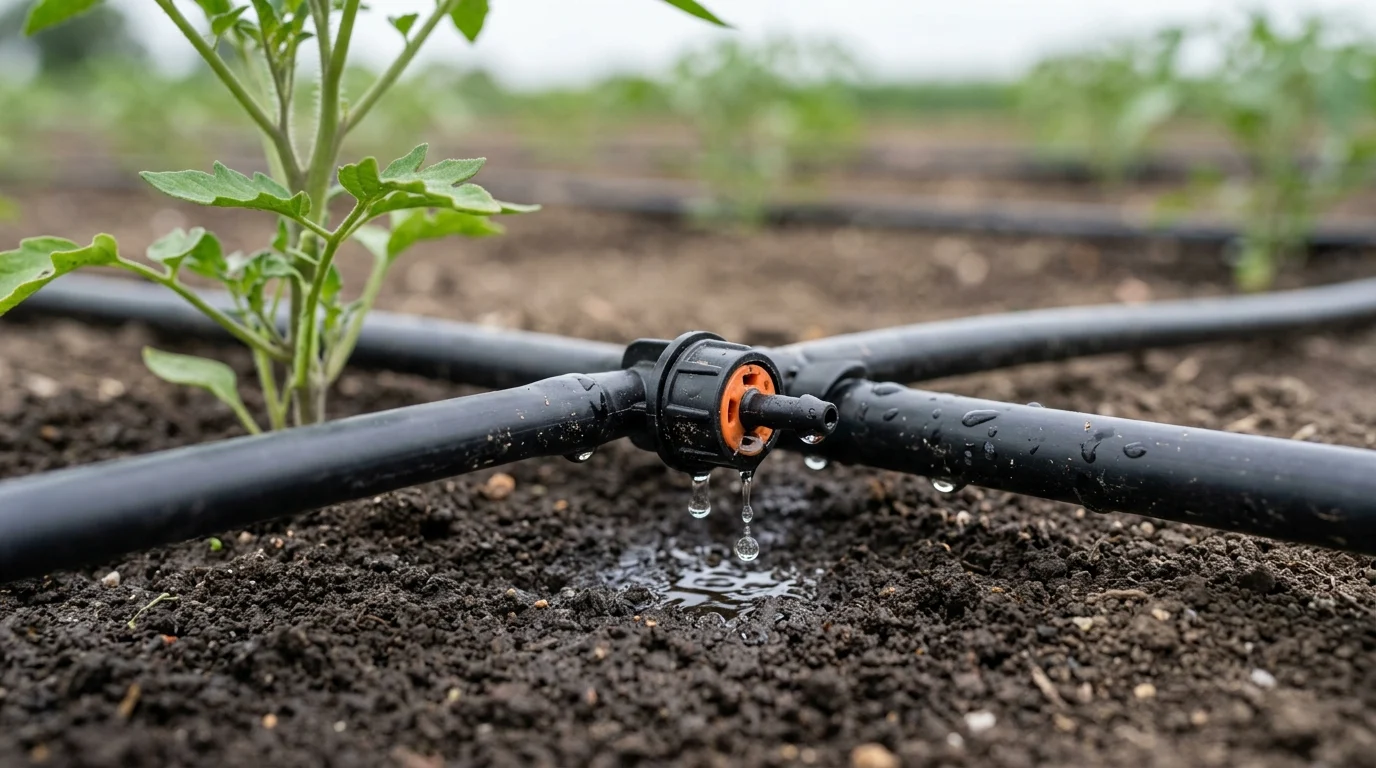
The selection of a drip irrigation emitter represents one of the most critical design decisions in modern precision agriculture. Serving as the final interface between the hydraulic distribution network and the plant root zone, the emitter dictates the precise volume and rate of water delivery. A mismatch between emitter specifications and field conditions can lead to severe agronomic and financial consequences, including uneven crop yields, wasted water resources, and accelerated system degradation.
For agricultural engineers and farm managers, evaluating drip irrigation technology requires moving beyond basic flow metrics. It necessitates a comprehensive analysis of topography, soil physics, crop water demand, and hydraulic dynamics to ensure that the chosen system maximizes resource-use efficiency while minimizing operational expenditures.
How emitter choice affects irrigation uniformity
The primary objective of any micro-irrigation system is to achieve high Emission Uniformity (EU), ensuring every plant within a designated irrigation block receives an identical volume of water and dissolved nutrients. Expertly designed systems target an EU of 90% or higher. When emitter choice is suboptimal, hydraulic friction and elevation changes cause pressure differentials along the lateral lines, resulting in uneven discharge rates.
This variation is measured by the manufacturer's Coefficient of Variation (CV). A high-quality drip irrigation emitter typically demonstrates a CV of less than 5%, meaning manufacturing anomalies have a negligible impact on flow consistency. If a system utilizes emitters with a high CV or fails to account for pressure variations, the resulting non-uniformity forces operators to over-irrigate to ensure the least-watered plants receive adequate moisture, thereby wasting water and leaching nutrients.
Which farm variables influence emitter selection
Selecting the optimal emitter requires an intimate understanding of specific farm variables, primarily soil texture, topography, and crop architecture. Soil texture dictates the wetting pattern; sandy soils exhibit high vertical infiltration rates and low lateral spread, demanding closer emitter spacing (e.g., 15 to 30 cm) and higher flow rates (up to 8.0 L/h) to prevent deep percolation below the root zone. Conversely, heavy clay soils require lower flow rates (often between 0.5 and 1.0 L/h) and wider spacing to prevent surface runoff and waterlogging.
Topography is equally decisive. Undulating terrain or steep slopes introduce significant pressure variations within the irrigation network. A 10-meter change in elevation corresponds to a 1.0 bar change in pressure. On flat terrain, simple non-compensating emitters may suffice, but sloped fields mandate specialized pressure-regulating designs to maintain consistent discharge rates regardless of elevation.
Types of drip irrigation emitters to compare
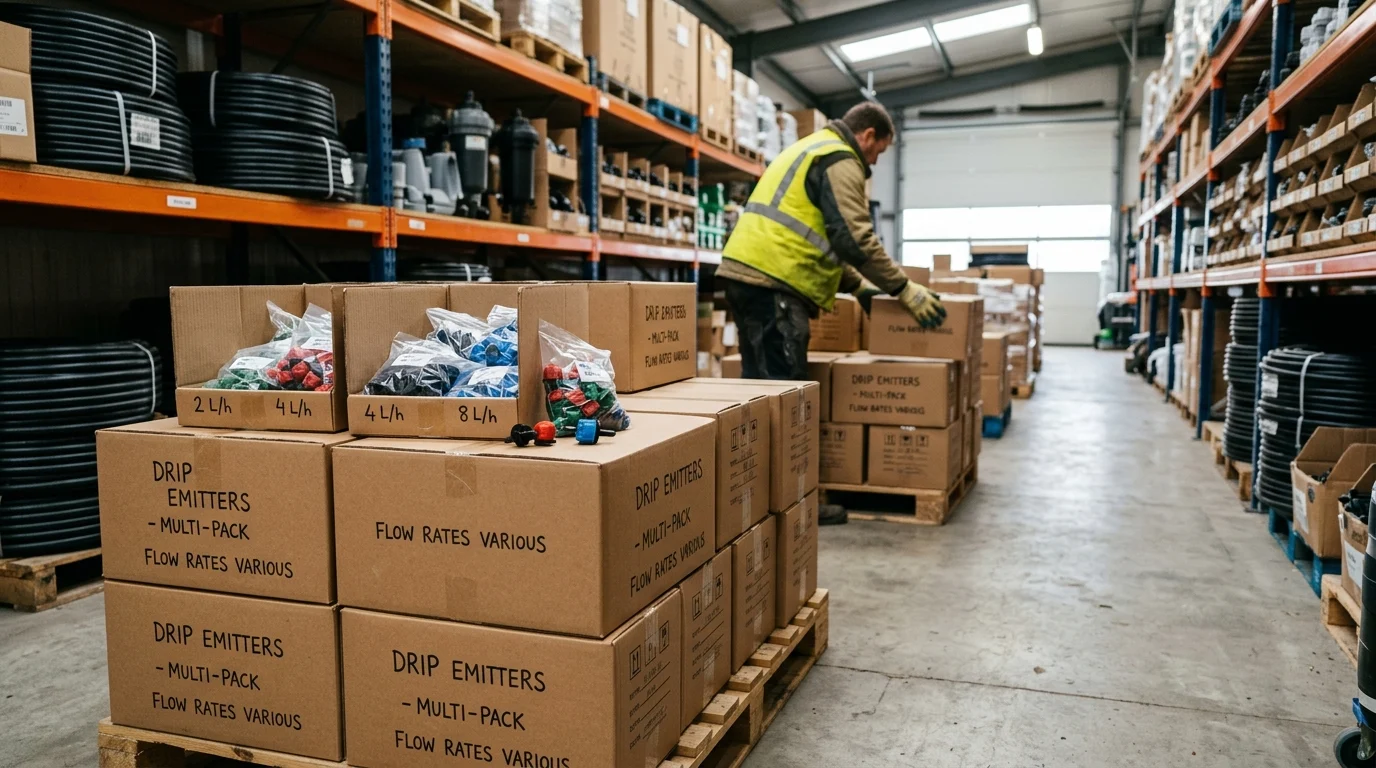
The market offers a diverse array of drip irrigation emitters, categorized primarily by their integration with the distribution tubing and their hydraulic response to pressure variations. Understanding the structural and functional differences between these categories is essential for specifying a system that aligns with the crop lifecycle and field logistics.
Inline vs online and pressure-compensating vs non-pressure-compe
nsating emitters
Emitters are structurally classified as either inline or online. Inline emitters are cylindrical or flat devices welded into the interior wall of polyethylene (PE) tubing during the extrusion process. They are predominantly used in row crops and high-density plantings due to their streamlined profile, which facilitates mechanized deployment and retrieval. Online emitters, conversely, are discrete units manually punched into the exterior of blank PE laterals. This allows for customized spacing, making them the standard choice for orchards and vineyards where plant spacing may be irregular or require adjustment over time.
Hydraulically, emitters are divided into pressure-compensating (PC) and non-pressure-compensating (NPC) models. PC emitters utilize an internal silicone diaphragm that dynamically adjusts the flow path cross-section in response to pressure changes. This guarantees a constant flow rate across a wide pressure spectrum, typically ranging from 0.5 to 4.0 bar. NPC emitters rely solely on a labyrinth flow path; their discharge rate fluctuates as a function of operating pressure.
| Feature | Pressure-Compensating (PC) | Non-Pressure-Compensating (NPC) |
|---|---|---|
| Flow Consistency | Constant across pressure range (e.g., 0.5-4.0 bar) | Varies with line pressure |
| Terrain Suitability | Sloped, undulating, or very long lateral runs | Flat terrain with short lateral runs |
| Internal Mechanism | Silicone diaphragm and labyrinth | Labyrinth flow path only |
| Cost Profile | Higher initial capital expenditure | Lower initial capital expenditure |
Flow rate, spacing, and wetting pattern differences
Emitter flow rates generally span from ultra-low (0.5 L/h) to high capacity (8.0 L/h or more). The selection of flow rate and physical spacing directly governs the application rate (measured in mm/hr) and the resulting subsurface wetting pattern. The goal is to create a continuous wetted strip along the crop row without exceeding the soil's basic infiltration rate.
For example, a high-density almond orchard grown in loam soil might utilize an online emitter configuration with two lateral lines per row, featuring 2.0 L/h emitters spaced every 60 cm. This specific combination provides a broad, overlapping wetting pattern that encourages expansive root development, which is critical for tree stability and nutrient uptake during peak evapotranspiration periods.
How to compare clogging resistance
Clogging is the primary failure mode for micro-irrigation systems. An emitter's resistance to clogging is largely determined by its labyrinth design—the tortuous internal pathway that reduces water pressure. Advanced emitters feature wide, deep cross-sectional areas and highly turbulent flow dynamics that keep particulates in suspension until they are flushed out.
When comparing specifications, the physical dimensions of the flow path are critical. A flow path depth of greater than 1.0 mm is generally considered highly resistant to physical blockages. Additionally, many modern PC emitters incorporate a self-flushing mechanism where the internal diaphragm flexes during system startup and shutdown, purging accumulated debris from the chamber.
How to evaluate emitter performance for water quality
Water quality is the single most restrictive parameter in drip irrigation design. Regardless of how sophisticated the drip irrigation emitter is, introducing heavily contaminated water without proper mitigation will inevitably lead to systemic failure. Evaluating emitter performance requires a rigorous analysis of the water source—whether surface water, borewell, or reclaimed effluent—and implementing a corresponding management strategy.
How water contaminants affect emitter performance
Contaminants are classified into physical, chemical, and biological categories. Physical contaminants like sand, silt, and clay physically occlude the emitter labyrinth. If Total Suspended Solids (TSS) exceed 50 mg/L, heavy wear and rapid clogging are highly probable. Chemical clogging typically results from the precipitation of calcium carbonate, iron, or manganese when groundwater is exposed to oxygen or pH shifts. Water with a hardness exceeding 300 mg/L (as CaCO3) poses a severe scaling risk.
Biological contaminants, such as algae and bacterial slime, are prevalent in surface water and reclaimed effluent. These organisms thrive in the nutrient-rich, warm environment of lateral lines, secreting extracellular polymers that bind with fine silt to form impenetrable blockages within the emitter's microchannels.
Filtration, chemical treatment, and maintenance requirements
To safeguard the emitter network, robust primary and secondary filtration is mandatory. The general rule is that the filter's aperture must be one-tenth the size of the emitter's smallest flow path dimension. For standard agricultural emitters, this typically translates to a filtration requirement of 100 to 130 microns (equivalent to 150 to 120 mesh). Media filters are preferred for organic loads, while hydrocyclones and disc filters are utilized for inorganic particulate removal.
Beyond mechanical filtration, chemical treatment protocols are essential for long-term maintenance. Acid injection is routinely used to lower the irrigation water pH to between 5.5 and 6.5, solubilizing calcium and iron precipitates. Concurrently, controlled chlorination (maintaining 1.0 to 2.0 ppm of free residual chlorine at the end of the lateral) is deployed to oxidize biological growth and prevent bacterial slime accumulation inside the emitters.
Which supplier documents and warranty terms to review
When procuring commercial quantities of emitters, a rigorous review of supplier documentation mitigates operational risk. Reputable manufacturers will provide technical datasheets detailing the emitter's performance curve, CV, and minimum filtration requirements. Crucially, the product should certify compliance with ISO 9261, the international standard for agricultural irrigation equipment, which dictates strict testing protocols for flow uniformity and mechanical durability.
Warranty terms must also be scrutinized. For permanent installations utilizing heavy-wall driplines (e.g., 0.9 mm to 1.2 mm wall thickness), warranties typically cover 5 to 10 years. Buyers must verify that the warranty explicitly covers environmental stress cracking resistance (ESCR) and UV degradation, and fully understand the manufacturer's stipulations regarding maximum operating pressure and mandatory filtration standards required to keep the warranty valid.
How to choose the best drip irrigation emitter
Finalizing the procurement of a drip irrigation emitter requires balancing agronomic ideals with hydraulic realities and budget constraints. A systematic approach ensures that the chosen technology delivers the required performance across its intended lifecycle, yielding a favorable return on investment.
A step-by-step emitter selection process
A structured selection process begins with a comprehensive site survey. Step one is calculating the peak crop water demand (ETc) to establish the maximum daily volume the system must deliver. Step two involves analyzing soil texture to define the maximum allowable application rate, preventing runoff.
Step three requires mapping the field topography to decide between PC and NPC emitters. If elevation varies by more than 5%, PC emitters are non-negotiable for maintaining uniformity. Finally, step four integrates water quality test results to select an emitter with an appropriate labyrinth size and self-flushing capabilities, matching it with the necessary head control filtration.
How to compare total cost of ownership
Evaluating the financial viability of an emitter system requires moving beyond the initial purchase price and calculating the Total Cost of Ownership (TCO) over a defined period, typically 5 to 10 years. Thin-wall tapes with integrated emitters represent a low initial capital expenditure (CAPEX) but require frequent replacement, driving up operational expenditure (OPEX) in labor and disposal.
Conversely, heavy-wall PC driplines demand a high initial CAPEX but offer superior longevity, reduced maintenance, and highly efficient water and fertilizer application, which lowers long-term OPEX.
| Cost Category | Thin-Wall Seasonal Tape (e.g., 0.15 mm) | Heavy-Wall PC Dripline (e.g., 1.0 mm) |
|---|---|---|
| Initial CAPEX ($/acre) | $150 – $300 | $800 – $1,200 |
| Expected Lifespan | 1 to 3 crop seasons | 10 to 15+ years |
| Labor / Replacement Cost | High (annual retrieval/installation) | Low (permanent installation) |
| Maintenance / Flushing | Moderate to High | Low (often self-flushing) |
How to balance agronomic fit and hydraulic performance
The ultimate success of the irrigation design lies in harmonizing agronomic fit with hydraulic performance. Agronomically, the emitter must deliver water and nutrients directly to the active root zone at a rate that the soil matrix can absorb. If a heavy clay soil has a basic infiltration rate of 4.0 mm/hr, the selected emitter flow rate and spacing must yield an application rate strictly below this threshold to maintain soil aeration and prevent anaerobic conditions.
Hydraulically, the chosen emitter must allow for practical irrigation block sizes. Utilizing ultra-low-flow emitters (e.g., 0.7 L/h) enables longer lateral runs and larger irrigation zones, which reduces the required diameter of sub-mains and lowers the overall cost of the PVC distribution network and pumping infrastructure. By meticulously aligning the emitter's technical specifications with the physical realities of the farm, operators can engineer a highly resilient, automated, and efficient irrigation system.
Key Takeaways
- The most important conclusions and rationale for drip irrigation emitter
- Specs, compliance, and risk checks worth validating before you commit
- Practical next steps and caveats readers can apply immediately
Frequently Asked Questions
When should I choose pressure-compensating emitters?
Use PC emitters on sloped, long, or uneven-pressure fields. They keep flow stable across roughly 0.5–4.0 bar and help maintain high irrigation uniformity.
What emitter flow rate fits sandy or clay soil?
Sandy soil usually needs closer spacing and higher flow, often up to 8.0 L/h. Clay soil generally works better with lower flow, about 0.5–1.0 L/h, to avoid runoff and waterlogging.
Should I use inline or online drip emitters?
Choose inline emitters for row crops and uniform spacing because installation is faster. Choose online emitters for orchards or vineyards where plant spacing is irregular or may change.
Why does emitter CV matter?
CV shows how consistent emitter flow is from unit to unit. Aim for a high-quality emitter with CV below 5% to improve emission uniformity and reduce over-irrigation.
How does field elevation affect emitter selection?
A 10-meter elevation change creates about 1.0 bar pressure difference. On sloped land, select pressure-compensating emitters to prevent uneven watering from top to bottom of the field.