
Introduction
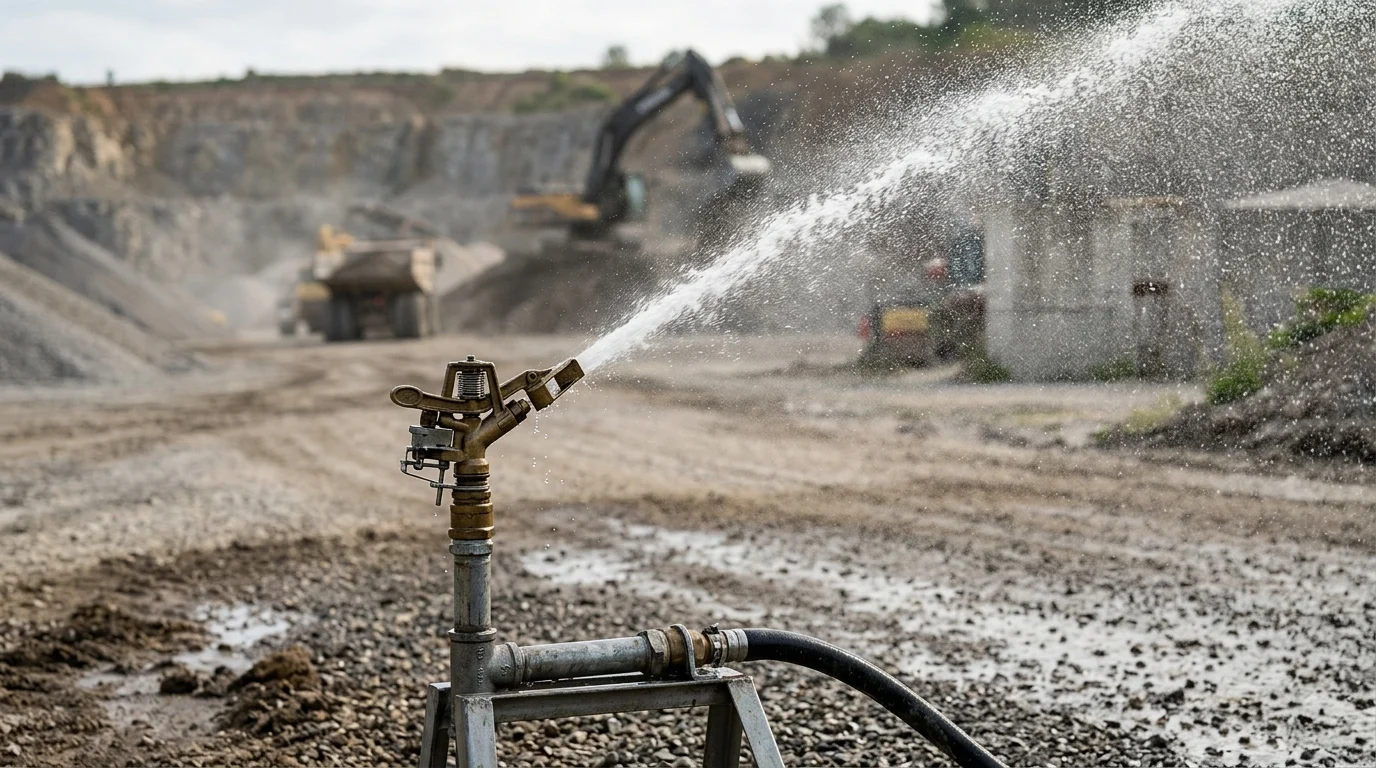
Mining sites produce dust at haul roads, stockpiles, transfer points, and blasting areas, where airborne particles can affect worker exposure, visibility, equipment reliability, and regulatory compliance. Impact sprinklers offer a practical way to cover large outdoor areas, but their performance depends on more than simply applying water. Factors such as droplet size, pressure, nozzle selection, placement, wind, and operating schedules determine whether dust is actually captured or just redistributed. This article explains how impact sprinkler dust suppression works in mining, where it performs best, and how to configure and maintain systems for efficient coverage, lower water waste, and more reliable control under demanding site conditions.
Why impact sprinkler dust suppression matters in mining
Fugitive dust emissions in mining operations represent a critical operational, environmental, and occupational health challenge. Regulatory frameworks, such as the Mine Safety and Health Administration (MSHA) standard limiting respirable crystalline silica exposure to 50 µg/m³ over an 8-hour shift, demand rigorous mitigation strategies. Implementing impact sprinkler dust suppression systems provides a scalable, mechanical solution to control airborne particulates across expansive, rugged topographies.
Key dust sources in mining operations
Mining sites generate particulate matter (PM10 and PM2.5) across multiple operational nodes. Primary sources include unpaved haul roads, where heavy vehicular traffic pulverizes surface materials, and open-air stockpiles vulnerable to wind erosion. Additionally, dynamic activities such as blasting, loading, and unloading at conveyor transfer points continuously eject large volumes of localized fugitive dust, requiring targeted moisture application to force particles to settle.
Operating conditions that affect suppression performance
The efficacy of any suppression system hinges on environmental variables. High wind velocities—often exceeding 15 to 20 mph on exposed pit benches—can severely disrupt spray patterns and accelerate evaporation before water reaches the dust source. Furthermore, extreme temperature fluctuations dictate operational parameters; ambient heat increases the required precipitation rate to maintain surface crusting, while sub-freezing conditions necessitate specialized winterization protocols to prevent catastrophic pipe and sprinkler head ruptures.
How impact sprinkler dust suppression works
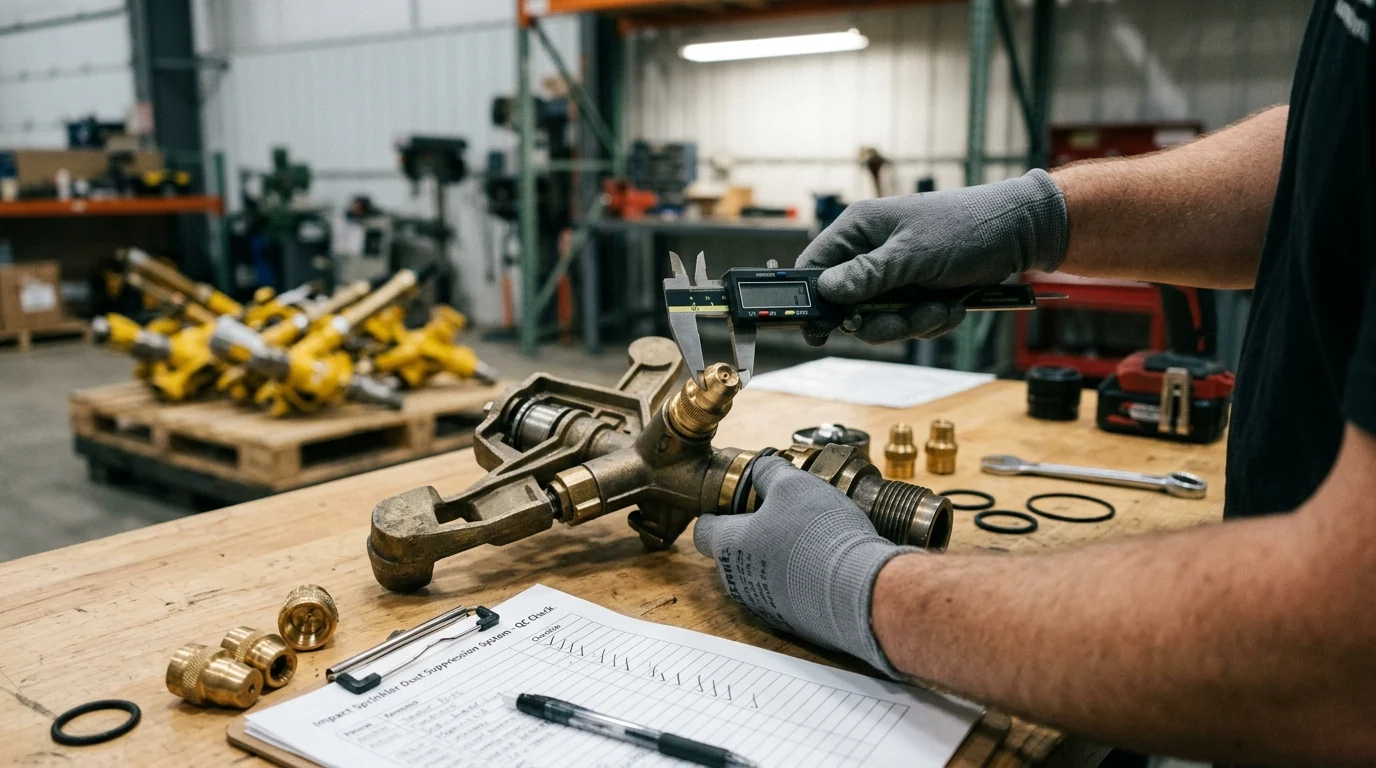
Impact sprinklers operate via a simple yet highly reliable mechanism: the kinetic energy of the water stream strikes a spring-loaded arm, rotating the nozzle assembly. This design allows for continuous, sweeping coverage over wide areas, dispensing water droplets configured to intercept and ground airborne dust without over-saturating the terrain.
Droplet size, throw radius, pressure, and nozzle selection
Effective particulate capture requires matching water droplet sizes to dust particle diameters. If droplets are too large, they create an aerodynamic slipstream that pushes fine dust aside; if too small, they evaporate or drift. Impact sprinklers typically generate droplets in the 200- to 500-micron range, which is ideal for suppressing heavier PM10 dust and wetting ground surfaces. Operating at moderate pressures of 40 to 100 PSI, heavy-duty brass or engineered polymer nozzles can achieve throw radii exceeding 150 feet, ensuring extensive volumetric coverage across large mining zones.
How to match systems to mining applications
System design must align with specific topographical and operational layouts. For active haul roads, part-circle impact sprinklers ensure water is directed only onto the driving surface, preventing hazardous pooling or wasted water on adjacent barren land.
| Trajectory Angle | Wind Resistance | Typical Mining Application |
|---|---|---|
| Low (10° – 14°) | High | Exposed stockpiles, high-wind haul roads |
| Standard (23° – 27°) | Moderate | Deep pits, sheltered transfer points |
| High (30°+) | Low | Specialized vertical pile suppression |
Selecting the correct trajectory and utilizing specialized products ensures water reaches the target zone effectively, minimizing evaporative loss and maximizing the operational lifespan of the suppression network.
Impact sprinklers vs misting and water sprays
While impact sprinklers are a foundational tool, mining operators frequently evaluate them against alternative suppression technologies, such as high-pressure misting cannons and mobile water trucks. Understanding the mechanical and financial trade-offs is essential for optimizing dust control infrastructure.
Decision criteria for comparing dust suppression methods
The primary decision criteria revolve around water availability, energy consumption, and target area characteristics. High-pressure misting systems generate ultra-fine droplets (under 50 microns) using pumps that operate at 1,000 PSI or higher. This requires significant electrical infrastructure and highly filtered water to prevent rapid nozzle clogging. In contrast, impact sprinklers tolerate lower water quality (e.g., total suspended solids up to 50 mg/L) and function on standard industrial pump pressures. Mobile water trucks offer flexibility but incur high diesel, labor, and maintenance costs, routinely exceeding $100 per operating hour depending on fuel prices and fleet age.
When impact sprinklers are the best choice
Impact sprinklers excel in expansive, static environments subject to variable weather. They are the superior choice for large-scale stockpiles, long-term haul roads, and leach pads where continuous, automated surface wetting is required. Because their larger droplets resist wind deflection, impact sprinklers maintain their precipitation footprints in conditions where fine mist would be entirely blown away from the suppression zone, rendering misting systems ineffective in highly exposed open-pit operations.
Implementation and maintenance best practices
A well-engineered sprinkler network relies on precise hydraulic modeling and rigorous maintenance protocols to ensure long-term reliability in highly abrasive mining environments.
System layout, spacing, pipework, and pumping
Proper layout dictates head-to-head spacing, typically requiring a 50% to 60% overlap of the sprinkler throw diameters to achieve uniform distribution and prevent dry spots. Pipework, often constructed from high-density polyethylene (HDPE) for its durability and flexibility, must be sized to minimize friction loss over long distances. Pumping stations must be configured with variable frequency drives (VFDs) to maintain consistent pressure (e.g., a steady 80 PSI operating baseline) across elevation changes and fluctuating system demands.
Maintenance, inspection, winterization, and water quality
Mining water is notoriously harsh, often containing high levels of dissolved minerals and suspended solids. Regular inspection of nozzle orifices for wear and bearing assemblies for grit intrusion is mandatory to prevent rotation failure. In climates experiencing freezing temperatures, automated drain valves must be installed at low points. A standard winterization procedure involves purging the lines with compressed air at approximately 50 PSI to evacuate residual water, preventing ice expansion from fracturing the infrastructure.
Environmental, safety, and permitting considerations
Over-application of water leads to localized flooding, unstable haul roads, and environmentally hazardous runoff. Systems must be calibrated to apply just enough moisture to maintain the soil’s cohesive crust—often requiring precipitation rates of less than 0.1 to 0.2 inches per hour. Adhering to these tight application rates ensures compliance with local environmental agency permits regarding water conservation and prevents heavy-metal-contaminated runoff from breaching site perimeters.
How to evaluate fit and ROI
Transitioning to an automated impact sprinkler network requires a substantial initial capital expenditure. However, rigorous evaluation of site data and operational metrics typically demonstrates a compelling return on investment (ROI) over the lifecycle of the mine.
Site data, KPIs, and pilot testing
Operators must establish baseline metrics using perimeter dust monitors to track PM10 concentrations before and after installation. Key Performance Indicators (KPIs) include the percentage reduction in daily water consumption and the decrease in labor hours previously allocated to manual watering. Pilot testing a localized zone—such as a single 500-foot stretch of haul road—allows engineers to fine-tune nozzle sizes and watering schedules before scaling the system site-wide. For customized pilot programs and precise hydraulic calculations, operators should contact us to align engineering specifications with exact site demands.
Balancing dust reduction targets and total cost
The financial justification balances the upfront costs of pumps, piping, and sprinklers against ongoing operational savings. Automated systems eliminate the diesel fuel, vehicular wear, and dedicated labor associated with mobile water trucks. Furthermore, effective ambient suppression reduces premature wear on heavy machinery engines and heavy-duty air filtration systems.
| Cost Factor | Automated Impact Sprinklers | Mobile Water Trucks |
|---|---|---|
| Capital Expenditure (CAPEX) | High ($50,000 – $200,000+) | Low to Moderate (if leased) |
| Operational Expenditure (OPEX) | Low (Electricity, basic maintenance) | High (Diesel, labor, vehicle wear) |
| Water Efficiency | High (Targeted, minimal pooling) | Low (Uneven, heavy application) |
| Typical ROI Payback | 12 to 24 Months | N/A (Continuous sunk cost) |
Ultimately, a properly engineered impact sprinkler system transforms dust suppression from a reactive, labor-intensive chore into a controlled, predictable utility. By systematically evaluating performance data against total lifecycle costs, mine operators can safeguard both operational profitability and stringent regulatory compliance.
Further reading:
Key Takeaways
- The most important conclusions and rationale for impact sprinkler dust suppression
- Specs, compliance, and risk checks worth validating before you commit
- Practical next steps and caveats readers can apply immediately
Frequently Asked Questions
Where are impact sprinklers most effective in mining dust suppression?
They work best on haul roads, stockpiles, pit perimeters, and conveyor transfer zones where dust is persistent and coverage must be wide and repeatable.
What pressure range is usually recommended for impact sprinkler dust suppression?
Most mining setups perform well around 40–100 PSI, which supports stable rotation, useful throw distance, and droplets large enough to settle PM10 dust.
How can impact sprinklers reduce water waste on mine roads?
Use part-circle heads, correct spacing, and low-angle trajectories so water lands on the traffic surface instead of shoulders, berms, or unused ground.
Do impact sprinklers work well in windy mining conditions?
Yes, if you use lower trajectory angles, adjust spacing, and increase cycle frequency. This helps keep droplets on target and limits drift and evaporation.
Why choose heavy-duty impact sprinklers from suppliers like ZM INOVATO?
For mining, durable brass or engineered polymer models handle abrasive conditions, broad coverage needs, and moderate water quality better than finer mist systems.


