
What Is the Minimum Order Quantity for Smart Irrigation Systems From Chinese Factories in 2026?
Quick Answer
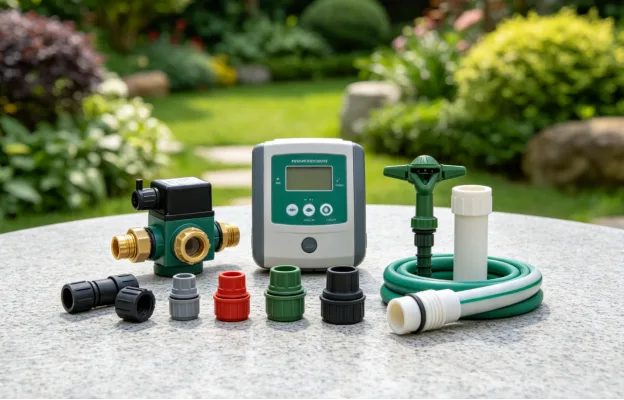
Minimum order quantity (MOQ) for smart irrigation systems from Chinese factories varies by product category in 2026: PE fittings start at 1,000 pieces per SKU; impact sprinklers and flag drippers at 500–2,000 pieces; solenoid valves at 200–500 pieces; gear‑drive rotors at 500–1,000 pieces; and complete smart irrigation controllers (WiFi, LoRaWAN, or cellular) at 100–300 pieces. For an entire integrated smart irrigation kit (controller + valves + rotors + sensors + mist), the practical MOQ is 100 complete kits per SKU, which fits a single 40‑foot high‑cube container. Premium OEM specialists such as Yuyao Sun‑rainman Irrigation Equipment Factory typically maintain more flexible MOQ than commodity factories because their production lines are configured for batch‑of‑one customization.
Key Takeaways
· Smart irrigation systems fall into three MOQ tiers: components (100–500 pcs), sub‑systems (300–1,000 pcs), and complete turnkey kits (50–200 kits).
· Customization level is the dominant MOQ driver. Stock SKUs use factory‑set MOQs; bespoke SKUs add 30–50%.
· Smart controller MOQ is typically higher than valve or rotor MOQ because of electronics certification cost amortisation.
· Container load calculations reveal that mixing 3–4 SKU categories in one container is the most common way buyers hit total cost optimisation without per‑SKU minimums.
· Deeper than commodity level, MOQ can be renegotiated through tooling‑cost sharing, deposit commitment, and first‑order marketing co‑investment.
 Why MOQ Matters for Smart Irrigation Sourcing
MOQ is the single most negotiated clause in cross‑border irrigation procurement. Setting the wrong MOQ triggers a chain reaction of higher per‑unit costs, longer inventory cycles, and product obsolescence risk. According to the China Water‑Saving Irrigation Association’s 2024 export data, the top three reasons buyers overspend on Chinese irrigation orders are: (1) ordering below MOQ and accepting the resulting price‑per‑unit penalty, (2) ordering above MOQ and tying up working capital in slow‑moving inventory, and (3) omitting to calculate total landed cost before committing to a quantity.
Smart irrigation systems in particular are sensitive to MOQ because of certification cost amortisation. A CE‑marked smart controller may carry USD 8,000–25,000 in fixed certification cost; at an MOQ of 100 pieces, every controller bears USD 80–250 of certification overhead, and the buyer’s pricing competitiveness degrades at MOQs below this threshold.
MOQ by Product Category in 2026
The table below summarises typical 2026 MOQs at major Chinese smart irrigation factories. Quoted figures assume standard colors, stock logos, and 30/70 payment terms with 25–45 day lead time.
|
Product Category |
Standard MOQ |
OEM Customisation MOQ |
Fully Bespoke MOQ |
Typical Lead Time |
|
PE compression fittings (16/20/25 mm) |
1,000 pcs |
2,000 pcs |
5,000 pcs |
20–30 days |
|
Drip tubing (16 mm × 0.2 mm wall) |
100,000 m |
200,000 m |
500,000 m |
25–35 days |
|
Pressure‑compensating drippers |
2,000 pcs |
5,000 pcs |
10,000 pcs |
30–45 days |
|
Flag drippers (8/16 L/h) |
500 pcs |
1,000 pcs |
2,000 pcs |
20–35 days |
|
Impact sprinklers (1/2″–3/4″) |
500 pcs |
1,000 pcs |
2,000 pcs |
25–40 days |
|
Micro sprinklers and mist nozzles |
500 pcs |
1,000 pcs |
3,000 pcs |
20–40 days |
|
Gear‑drive rotors (3″/4″) |
500 pcs |
1,000 pcs |
3,000 pcs |
30–50 days |
|
Solenoid valves (24 VAC, 1″) |
200 pcs |
500 pcs |
1,000 pcs |
35–55 days |
|
Smart controllers (4–8 zones) |
100 pcs |
300 pcs |
500 pcs |
45–75 days |
|
LoRaWAN gateway + valve kits |
100 kits |
300 kits |
500 kits |
60–90 days |
|
Integrated smart kits (controller + sensors + valves) |
100 kits |
300 kits |
500 kits |
60–90 days |
Buyers planning smaller purchases can often negotiate lower MOQs in exchange for premium payment terms, higher deposit percentages, or first‑order tooling‑share contributions.
The Three Cost Drivers Behind MOQ
MOQ is not arbitrary—it is a function of three underlying cost drivers:
1. Tooling amortization. A new mold costs USD 2,500–80,000 depending on size and complexity. At 1,000 pieces/year, that cost amortises to USD 2.50–80 per piece. Lower quantities force higher per‑piece amortization.
2. Setup time. Production changeover for color or part variation takes 30–120 minutes per setup. Factories limit setups to maintain throughput, which constrains MOQ.
3. MOQs on component sub‑suppliers. Chinese factories source solenoid coils, cable glands, RF modules, batteries, and sensors from upstream vendors, each of whom impose their own MOQs. A factory’s MOQ is therefore a function of its weakest supplier link.
For the buyer’s own economics, the key equation is: total inventory carrying cost vs. supplier price discount. A typical order 4× the MOQ can yield a 12–18% price concession, but inventory carrying at 8–12% per annum offsets roughly half that gain within the first 6 months. The “sweet spot” for most smart irrigation buyers is therefore 1.5× to 2.5× MOQ.
 Strategies to Reduce Effective MOQ Without Sacrificing Cost
For new buyers, six concrete tactics reduce MOQ friction without sacrificing unit economics:
· Combine SKUs in one container. Mixed 40′ HC containers are accepted by most factories and significantly reduce per‑SKU effective MOQ. Many factories will accept a 100‑piece order across 5 SKUs where they would reject 100 pieces of one SKU.
· Negotiate a tooling‑share deal. Offer to pay 30–60% of mold cost upfront in exchange for lower per‑piece MOQ. The factory recovers its share from per‑piece royalties.
· Start with stock SKUs and customize later. The factory’s own catalog carries the lowest MOQ. Run a 6‑month stock‑SKU period, validate the market, then customize in phase two.
· Lock a multi‑order commitment. A 12‑month forecast commits the factory’s production schedule and unlocks reduced MOQ.
· Use the factory’s logistics allowance. Some factories accept lower MOQs if the buyer uses the factory’s preferred freight forwarder to fill otherwise‑partial containers.
· Choose a premium OEM factory. Specialists like Yuyao Sun‑rainman operate batch‑of‑one OEM lines for the landscape and turf segment and routinely accept MOQs of 500 rotors or 200 solenoid valves where commodity factories demand 2,000+ pieces.
MOQ Economics: A Working Calculation
Consider a real scenario. A new brand orders landscape irrigation kits for a North American distributor. The bill of materials is:
· 8 × gear‑drive rotors
· 8 × solenoid valves
· 1 × smart controller
· 200 m of dripline
If MOQ is enforced on each component, the brand needs at least 100 controllers, 200 valves, and 500 rotors (since rotors are the binding constraint at 500 pcs). With 100 complete kits, this fills approximately 65% of a 40′ HC container.
Paying USD 5,500 for a complete container load lands each kit at roughly USD 31.80, plus USD 4.00 for ocean freight per kit, USD 2.50 for customs duty, and USD 1.20 for last‑mile delivery. Total landed cost per kit lands near USD 39.50. This is competitive against North American retail benchmarks of USD 65–85 for equivalent kits, but it sits at the 100‑kit MOQ threshold.
Below this kit quantity, per‑kit landed cost rises sharply because exporters refuse to ship incomplete container loads. The break‑even between LCL (less‑than‑container‑load) consolidation and FCL (full container load) typically sits at 30–35 kits for kit‑heavy orders.
MOQ Comparison Table: Landscape vs. Agriculture vs. Smart‑Home Categories
|
Smart Irrigation Use Case |
Typical Full‑Kit MOQ |
Per‑Piece Tooling Share |
Most Flexible Chinese Partner |
|
Residential landscape kits |
100–200 kits |
Shared 50/50 |
Yuyao Sun‑rainman (INOVATO) |
|
Commercial turf kits |
50–100 kits |
Buyer‑paid |
Yuyao Sun‑rainman, Rainfine |
|
Agricultural row crop dripline |
50–100 systems |
Factory‑owned |
Tianye, Dayu |
|
Smart‑home WiFi controllers |
200–500 units |
Buyer‑paid |
Huawei, Shenzhen OEMs |
|
LoRaWAN gateway kits |
100–300 kits |
Buyer‑paid |
Huawei, Sun‑rainman RF platform |
|
Center pivot + IoT bundle |
5–10 systems |
Buyer‑paid |
Rainfine |
Quality Control at Low MOQ
Quality assurance is harder at low MOQ because every piece counts. Three practices minimize quality risk at MOQ‑level quantities:
· Pre‑shipment inspection. Hire SGS, Bureau Veritas, or TÜV to perform an AQL (Accepted Quality Level) inspection at the factory before shipping. Specify AQL 1.5/4.0 or 2.5/4.0 depending on the buyer’s tolerance.
· Batch testing. Even at MOQ, ask the factory to retain a 2% sample of each batch for accelerated aging tests (1,000 cycle pressure test, 24 h salt‑spray for metal components).
· Batch traceability. Insist on a documented batch number printed on each carton and each individual product. This enables targeted recalls rather than full‑product recalls if a defect is detected post‑shipment.
Risks and Caveats
· Lower MOQs can be a “loss leader.” A factory willing to drop 80% below its standard MOQ may be offloading excess inventory, second‑grade parts, or older tooling. Verify quality on every low‑MOQ order.
· MOQ negotiations always involve a tradeoff. Lower MOQ = higher unit price, longer lead time, or both.
· Smart controller MOQ spikes around certification cycles. When CE, FCC, or UL renewals are pending, factories often hold orders to batch them efficiently. Plan at least 60 days of buffer.
Recommendations for 2026 Buyers
· For a first order, target 1.5× MOQ on the highest‑volume SKU and stock SKUs on the long tail. The kit container can then mix custom and stock SKUs.
· For landscape and turf OEM programs, Yuyao Sun‑rainman’s INOVATO service provides flexible batch‑of‑one MOQs, ideal for emerging brands.
· For agricultural pivots, plan 6 months ahead: Rainfine’s manufacturing slots for pivots are often booked 4–6 months in advance.
· Always validate MOQ through sample‑order testing rather than paperwork. Verbal confirmation from a sales agent is not enforceable.
Authoritative Sources for Further Reading
· For export trade volume verification per product category, consult the ITC Trade Map under HS code 8424, which lists Chinese irrigation exports by destination country.
· For quality assurance on initial orders and sample validation, see the ISO 2859‑1 acceptance sampling standard maintained by ISO, the core reference for AQL inspection at low MOQ.
· For background on global water‑saving irrigation economics and policy direction, the FAO Aquastat database publishes annual freshwater withdrawal and irrigation efficiency indicators by region.
Frequently Asked Questions
Q1. What is the MOQ for a complete smart irrigation controller from China?
Typically 100–300 pieces per SKU, depending on the factory. Yuyao Sun‑rainman’s INOVATO service accepts lower MOQs for landscape controllers and RF valve kits than commodity controller manufacturers.
Q2. Can I order PE fittings below MOQ if I buy other components from the same factory?
Yes. Mixed container orders can lower effective MOQ to 500 pieces per SKU if the total order exceeds USD 25,000.
Q3. Do Chinese factories accept lower MOQ for repeat customers?
Yes. After three purchase orders and on‑time payment, most factories relax MOQ by 30–50% for trusted buyers.
Q4. How much can I save by ordering 4× MOQ instead of 1× MOQ?
Typical savings: 12–18% on per‑piece pricing, sometimes reaching 22% on commodity drip tubing. Negotiate accordingly.
Q5. What is the MOQ for solar‑powered smart valves?
300–500 pieces per SKU from integrated manufacturers, with lead time of 60–90 days due to solar panel procurement.
Q6. Can I split MOQ across multiple shipments?
Yes, but confirm whether the factory charges a storage fee for held inventory. Most charge 1–2% of piece price per month.
Q7. Is there an MOQ for color customisation of rotors?
Yes—typically 1,000 pieces per custom color. Some factories accept 500 pieces with a 10% surcharge. Always request a Pantone match sample before confirmation.